
rosanna deerchild, calling down the sky

From the publisher:
Calling Down the Sky is a poetry collection that describes deep personal experiences and post-generational effects of the Canadian Aboriginal Residential School confinements in the 1960’s when thousands of First Nations, Métis, and Inuit children were placed in these schools against their parents’ wishes.

Many were forbidden to speak their language and practice their own culture. Rosanna Deerchild exposes how the Residential Schools systematically undermined Aboriginal culture across Canada and disrupted families for generations, severing the ties through which Aboriginal culture is taught and sustained, and contributing to a general loss of language and culture.

The devastating effects of the residential schools are far-reaching and continue to have significant impact on Aboriginal communities.
rosanna deerchild, calling down the sky

people ask me all the time
about residential schools
as if it’s their business or something

ever since that white guy
nete in ottawa said he was sorry

as if
he knows anything about those places

he wasn’t there
he doesn’t know

he wasn’t there
when i needed comfort
when i cried

he doesn’t know
what that priest did
what those nuns did

you can’t say sorry
for those things
for what happened there

he’s got no right

share your story he says
what does that even mean

boy these misti-gu-su
and their fancy talk

share your story
as if it’s that easy

anyway
it was a long time ago

fifty years since those days
fifty years i said nothing

the words
they get caught right here
in my throat

where the nuns would grab
when we spoke Cree

as if grabbing a dead duck’s neck
haul us up in front of that class

stand there so long,
we pissed ourselves

you learn pretty quickly
to stay quiet after that boy

no
we never talk about it

not back home
not with each other
not even when it was happening,

you just tried to forget about it
leave it behind

some of us did
some of us are still trying

it always finds you though
drags you back

don’t make up stories
that’s what they told us kids

when we went back home
told them what was going on
in those schools

still got sent back
every year
less of us came home

still they said nothing
until we were nothing
just empty skins

full of broken english
ruler broken bones
bible broken spirits

and back home
became a broken dream

no damage done
for all but five years

that’s what it said in the letter
about my residential school story

dear claimant
no records
no proof

sorry

nine years
that’s how long
they kept me in there

i was just a baby
when they came for me

father died on the trapline
mother in the tb sanatorium

didn’t even get to say goodbye
never saw them again

nine years
you know what i got for that

deaf in one ear
blind in one eye

scars all over my head
my legs don’t work
arthritis

diabetes
from what we ate there
you know i never once saw fruit

can’t get no damn sleep
the dead keep me awake eh
ask me for forgiveness

but you can’t forgive and forget
the unnameable

there is no word for what they did
in our language

to speak it is to become torn
from the choking

money got no cure for that

now
i’m almost seventy

and you want me to
share my story

ok then
here it is
here in the unwritten
here in the broken lines
of my body that can never forget
Tribute to Service Workers by Laurie Uttich. November is Women abuse Prevention Month.

Laurie Uttich

TO MY STUDENT WITH THE DIME-SIZED BRUISES ON THE BACK OF HER ARMS WHO’S STILL ON HER CELLPHONE

Oh honey, you can text him, you can like his meme, you can
follow him on Twitter and to Target, you can ride shotgun, hold
his anger on your lap, pet his pride, be his ride or die. You can
wear those jeans he likes. You can discover Victoria’s
secret, buy a bra with a mind of its own. You can
recite I’m sorry like it’s a Bible verse and Snapchat the shit out


of those purple roses he bought you at Publix. You can try
every one of Cosmo’s 30 Ways to Give an Ultimate Blowjob.
You can remember the name of his mother, his best friend
in 2nd grade, the lunchroom lady who gave him extra
chicken strips on Tuesdays. You can grow out your bangs, toss
your hometown over your shoulder, sleep facing north
with your cheek in his back.
You can strip yourself for parts. But, baby,


it still won’t be enough. You can love him, but you can’t pull
his story out of the dark and slide your arms into it. You can’t
wash it and lay it flat in the sun to soften. You can’t
hold his face in both of your palms and watch tomorrow
bloom from the sheer wanting and waiting of it. It doesn’t
matter if his daddy talked with his hands or his bloodline
is marinated in booze or his mama loved his brother best.
You can’t fix what somebody else broke.


So, girl, put down your phone and pick up
your pen. Take a piece of the dark and put it on a page.
Sylvia Plath waits to wash your feet. And look,
Virginia Woolf has built you another room and painted
it pink. There’s a place for you at the table. Sit next to me;
I got here late. Oh, baby, don’t you feel it? You were knit
for wonder in your mother’s womb.
You were born for the driver’s seat.

—from Rattle #69, Fall 2020
Tribute to Service Workers

From: Citizen by Claudia Rankine

Rankine-Claudia-hr
Image Credit: CSU Fullerton
 .
 .
 .
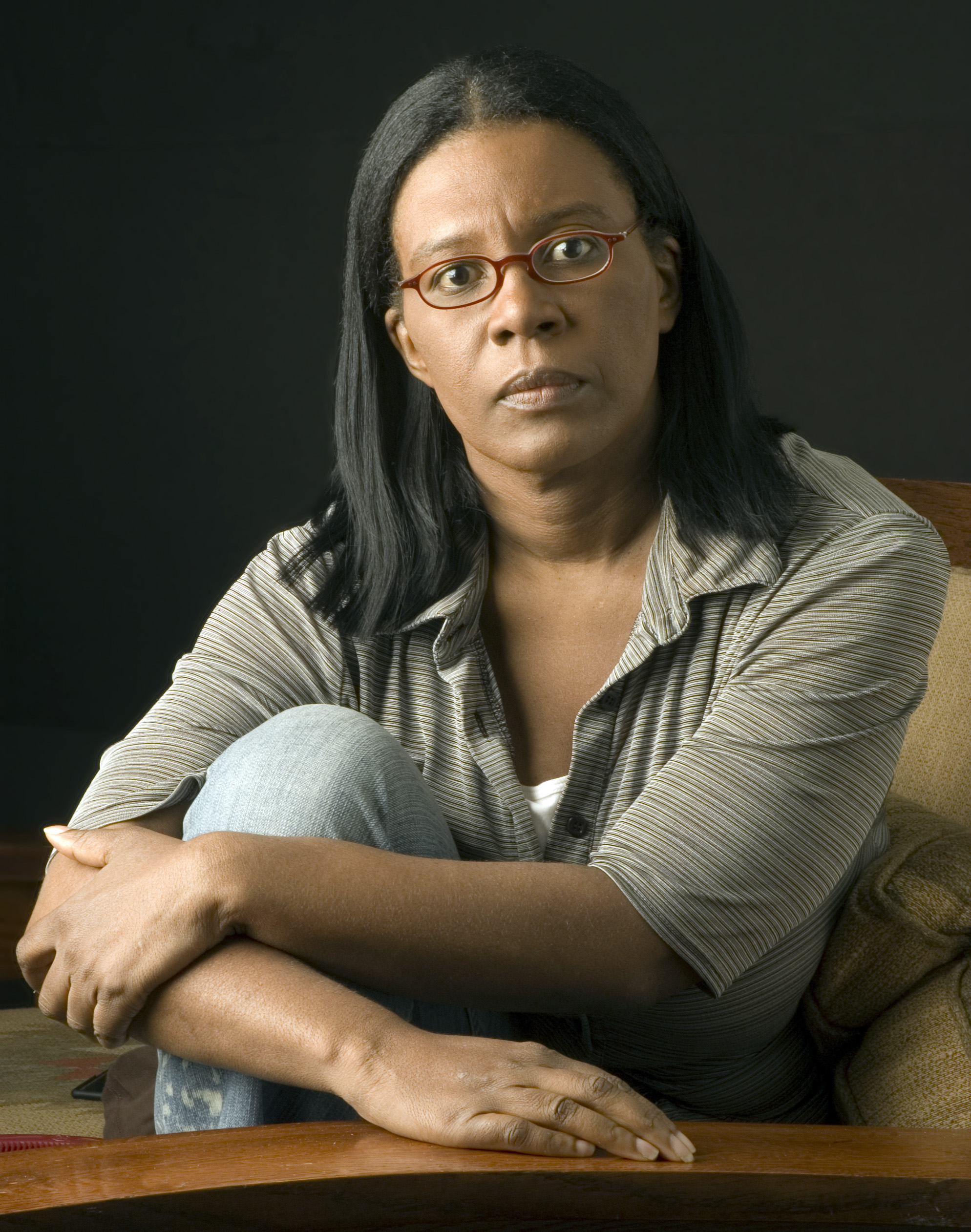
CLAUDIA RANKINE co-edited the anthology American Women Poets in the 21st Century: Where Lyric Meets Language, and her work is included in several anthologies, including Great American Prose Poems: From Poe to the Present, Best American Poetry 2001, Giant Step: African American Writing at the Crossroads of the Century, and The Garden Thrives: Twentieth Century African-American Poetry. Her work has been published in numerous journals including Boston Review, TriQuarterly, and The Poetry Project Newsletter. She lives and teaches in California. She is the Holloway/Mixed Blood poet for the spring series.
 .
 .
You are in the dark, in the car, watching the black-tarred street being swallowed by speed; he tells you his dean is making him hire a person of color when there are so many great writers out there.
/
You think maybe this is an experiment and you are being tested or retroactively insulted or you have done something that communicates this is an okay conversation to be having.
Why do you feel okay saying this to me? You wish the light would turn red or a police siren would go off so you could slam on the brakes, slam into the car ahead of you, be propelled forward so quickly both your faces would suddenly be exposed to the wind.
/
As usual you drive straight through the moment with the expected backing off of what was previously said. It is not only that confrontation is headache producing; it is also that you have a destination that doesn’t include acting like this moment isn’t inhabitable, hasn’t happened before, and the before isn’t part of the now as the night darkens 
and the time shortens between where we are and where we are going.
/
When you arrive in your driveway and turn off the car, you remain behind the wheel another ten minutes. You fear the night is being locked in and coded on a cellular level and want time to function as a power wash. Sitting there staring at the closed garage door you are reminded that a friend once told you there exists a medical term — John Henryism — for people exposed to stresses stemming from racism. They achieve themselves to death trying to dodge the build up of erasure. Sherman James, the researcher who came up with the term, claimed the physiological costs were high. You hope by sitting in 
silence you are bucking the trend.
/
When the stranger asks, Why do you care? you just stand there staring at him. He has just referred to the boisterous teenagers in Starbucks as niggers. Hey, I am standing right here, you responded, not necessarily expecting him to turn to you.
He is holding the lidded paper cup in one hand and a small paper bag in the other. They are just being kids. Come on, no need to get all KKK on them, you say.
Now there you go, he responds.
The people around you have turned away from their screens. The teenagers are on pause. There I go? you ask, feeling irritation begin to rain down. Yes, and something about hearing yourself repeating this stranger’s accusation in a voice usually reserved for your partner makes you smile.
/
A man knocked over her son in the subway. You feel your own body wince. He’s okay, but the son of a bitch kept walking. She says she grabbed the stranger’s arm and told him to apologize: I told him to look at the boy and apologize. And yes, you want it to stop, you want the black child pushed to the ground to be seen, to be helped to his feet and be brushed off, not brushed off  by the person that did not see him, has never seen him, has perhaps never seen anyone who is not a reflection of himself.
The beautiful thing is that a group of men began to stand behind me like a fleet of  bodyguards, she says, like newly found uncles and brothers.
/
The new therapist specializes in trauma counseling. You have only ever spoken on the phone. Her house has a side gate that leads to a back entrance she uses for patients. You walk down a path bordered on both sides with deer grass and rosemary to the gate, which turns out to be locked.
At the front door the bell is a small round disc that you press firmly. When the door finally opens, the woman standing there yells, at the top of her lungs, Get away from my house. What are you doing in my yard?
It’s as if a wounded Doberman pinscher or a German shepherd has gained the power of speech. And though you back up a few steps, you manage to tell her you have an appointment. You have an appointment? she spits back. Then she pauses. Everything pauses. Oh, she says, followed by, oh, yes, that’s right. I am sorry.
I am so sorry, so, so sorry.
/
.
 .
 .

BUY!
USED: http://www.abebooks.com/servlet/SearchResults?sts=t&tn=American+Women+Poets+in+the+21st+Century%3A+Where+Lyric+Meets+Language&x=0&y=0
NEW from Independent bookstores: http://www.indiebound.org/book/9780819565471