
/
BUY!
USED: http://www.abebooks.com/servlet/SearchResults?sts=t&tn=American+Women+Poets+in+the+21st+Century%3A+Where+Lyric+Meets+Language&x=0&y=0
NEW from Independent bookstores: http://www.indiebound.org/book/9780819565471
BUY!
USED: http://www.abebooks.com/servlet/SearchResults?sts=t&tn=American+Women+Poets+in+the+21st+Century%3A+Where+Lyric+Meets+Language&x=0&y=0
NEW from Independent bookstores: http://www.indiebound.org/book/9780819565471
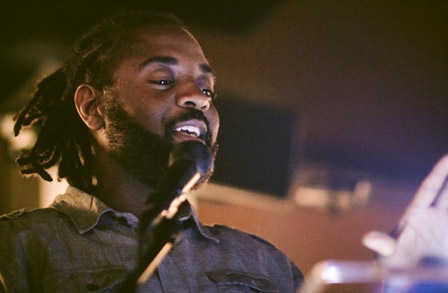
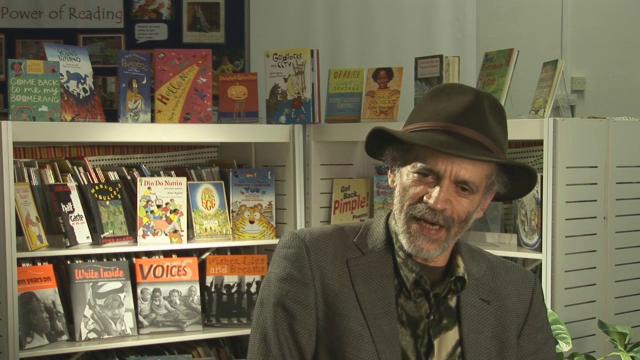
Black History Month- British black poet Shamshad Khan:
“High Time”
Black elephants
jazz dancing
gold and red
grin
i imagine
they wave
as they pass the window
of my third floor flat
just in case they are
i wave back
The Fire People: Collection of Contemporary Black British Poets
NEW and USED: Abebooks.com The Fire People
Rest in Peace, Rappers’ Legend, MC Big Bank Hank, of the legendary Sugar Hill Gang. Aged 58.
I remember “Rapper’s Delight”! (not the misogyny or the homophobia that is in there).
“I said a hip hop,
Hippie to the hippie,
The hip, hip a hop, and you don’t stop, a rock it
To the bang bang boogie, say, up jump the boogie,
To the rhythm of the boogie, the beat.
Now, what you hear is not a test – I’m rappin’ to the beat,
And me, the groove, and my friends are gonna try to move your feet.
See, I am Wonder Mike, and I’d like to say hello,
To the black, to the white, the red and the brown,
The purple and yellow…”
Beautiful poem on why care-takers deserve to become permanent residents in Canada (Filipina, Caribbean). Fill in the arguments. By James Weldon Johnson, African-American poet.
THE BLACK MAMMY
O whitened head entwined in turban gay,
O kind black face, O crude, but tender hand,
O foster-mother in whose arms there lay
The race whose sons are masters of the land!
It was thine arms that sheltered in their fold,
It was thine eyes that followed through the length
Of infant days these sons. In times of old
It was thy breast that nourished them to strength.
So often hast thou to thy bosom pressed
The golden head, the face and brow of snow;
So often has it ‘gainst thy broad, dark breast
Lain, set off like a quickened cameo.
Thou simple soul, as cuddling down that babe
With thy sweet croon, so plaintive and so wild,
Came ne’er the thought to thee, swift like a stab,
That it some day might crush thine own black child?
from Fifty Years & Other Poems (1917)
MY CITY- J.W. Johnson
When I come down to sleep death’s endless night,
The threshold of the unknown dark to cross,
What to me then will be the keenest loss,
When this bright world blurs on my fading sight?
Will it be that no more I shall see the trees
Or smell the flowers or hear the singing birds
Or watch the flashing streams or patient herds?
No, I am sure it will be none of these.
But, ah! Manhattan’s sights and sounds, her smells,
Her crowds, her throbbing force, the thrill that comes
From being of her a part, her subtle spells,
Her shining towers, her avenues, her slums–
O God! the stark, unutterable pity,
To be dead, and never again behold my city!


In poetry other answers to anger, trying to find some that fit, and enjoying finding new poets, happy with what I find:
Sapphics Against Anger
BY TIMOTHY STEELE
Angered, may I be near a glass of water;
May my first impulse be to think of Silence,
Its deities (who are they? do, in fact, they
Exist? etc.).
May I recall what Aristotle says of
The subject: to give vent to rage is not to
Release it but to be increasingly prone
To its incursions.
[…]
I did not write this poem — in anger. By Joel Dias-Porter
I did not write this poem
in anger,
I did not write this poem
in “Self-Defense.”
I did not write this poem.
Because my pen is empty from
having already written & written this poem.
– Joel Dias-Porter
Minnie Bruce Pratt
Justice, Come Down
[…]
I can smell my anger like sulfur-
struck matches. I wanted what had happened
to be a wall to burn, a window to smash.
At my fist the pieces would sparkle and fall.
All would be changed. I would not be alone. […]
From Violence to Peace
BY JIMMY SANTIAGO BACA
…I drove to Felipe’s house,
anger knotted in me
tight as the rope tied
to the stock trailer
steer strained against.
I pulled, but could not free myself. […]
“Felipe!” I yelled, porch light
flicked on, illuminating the yard.
“Came to fight,” I said, “take off
your glasses.” […]
First shot framed darkness round me
with a spillway of bright light,
eruption of sound, and second shot roared
a spray of brilliance and the third
gave an expanded halo-flash.
My legs woozed, and then
I buckled to the ground.
(I thought, holy shit, what ever happened
to the old yard-style fight between estranged friends!) […]
…During my week in bed,
pellets pollinated me
with a forgotten peace,
and between waking thoughts of anger and vengeance,
sleep was a small meadow of light,
a clearing I walked into and rested. Fragrance of peace
filled me as fragrance
of flowers and dirt permeate hands
that work in the garden all day…
Car seats on porches, lamp light and a torn willow tree in an open field.
From “Contemporary American Poetry” (1962) these lovely, happy poems about solitude:
Driving toward the Lac Qui Parle River
BY ROBERT BLY
I
I am driving; it is dusk; Minnesota.
The stubble field catches the last growth of sun.
The soybeans are breathing on all sides.
Old men are sitting before their houses on car seats
In the small towns. I am happy,
The moon rising above the turkey sheds.
[…]
III
Nearly to Milan, suddenly a small bridge,
And water kneeling in the moonlight.
In small towns the houses are built right on the ground;
The lamplight falls on all fours on the grass.
When I reach the river, the full moon covers it.
A few people are talking, low, in a boat.
Hunting Pheasants in a Cornfield
BY ROBERT BLY
I
What is so strange about a tree alone in an open field?
It is a willow tree. I walk around and around it.
The body is strangely torn, and cannot leave it.
At last I sit down beneath it.
II
It is a willow tree alone in acres of dry corn.
Its leaves are scattered around its trunk, and around me,
Brown now, and speckled with delicate black.
Only the cornstalks now can make a noise.
The sun is cold, burning through the frosty distances of space.
The weeds are frozen to death long ago.
Why then do I love to watch
The sun moving on the chill skin of the branches?
[…]
Robert Bly, “Driving toward the Lac Qui Parle River” from Silence in the Snowy Fields (Middletown, Conn.: Wesleyan University Press, 1962). Copyright © 1962 by Robert Bly.
USED: http://www.abebooks.com/servlet/SearchResults?an=donald+hall&sts=t&tn=Contemporary+American+Poetry
NEW: http://www.indiebound.org/book/9780140586183
Do you know of the poet Lula Lowe Weeden? She is amazing and has these surprises in her poems!
“Robin Red Breast”
Little Robin red breast,
I hear you sing your song.
I would love to have you put it into my little cage,
Into my little mouth.
“Dance”
Down at the hall at midnight sometimes,
You hear them singing rhymes.
These girls are dancing with boys.
They are too big for toys.
From “Caroling Dusk: an Anthology of Verse by Black Poets.” Edited by Countee Cullen.
NEW and USED: http://www.abebooks.com/servlet/BookDetailsPL?bi=12331091523
Alternative Anthem
Put the kettle on
Put the kettle on
It is the British answer
to Armageddon.
Never mind taxes rise
Never mind trains are late
One thing you can be sure of
and that’s the kettle, mate.
It’s not whether you lose
It’s not whether you win
It’s whether or not
you’ve plugged the kettle in.
May the kettle ever hiss
May the kettle ever steam
It is the engine
that drives our nation’s dream.
Long live the kettle
that rules over us
May it be limescale free
and may it never rust.
Sing it on the beaches
Sing it from the housetops
The sun may set on empire
but the kettle never stops.”
― John Agard, Alternative Anthem: Selected Poems
He has a twinkle in his eye!
London’s first young poet laureate!!!
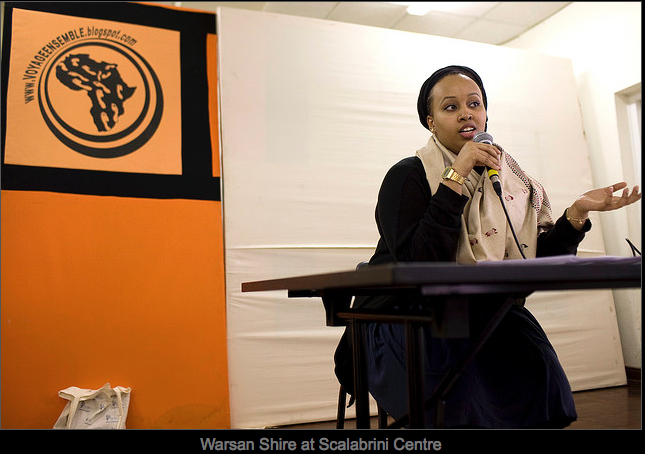
Teaching My Mother to Give Birth by Warsan Shire:
“later that night
i held an atlas in my lap
ran my fingers across the whole world
and whispered
where does it hurt?”
it answered
everywhere
everywhere
everywhere.”
― Warsan Shire
USED: http://www.abebooks.com/servlet/BookDetailsPL?bi=11212527987
NEW: http://www.indiebound.org/book/9781905233298

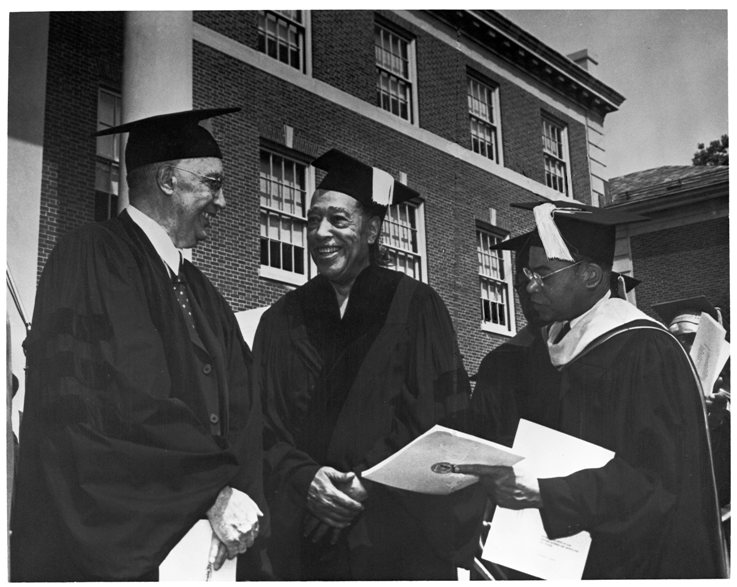
Professor Sterling Brown, Duke Ellington, G Frederick Stanton– http://www.howard.edu/msrc/treasures_howardiana_vips-honorees.html
Poems about The Body. Black poet Sterling A. Brown- Ma Rainey.
[…]
I talked to a fellow, an’ the fellow say,
“She jes’ catch hold of us, somekindaway.
She sang Backwater Blues one day:
‘It rained fo’ days an’ de skies was dark as night,
Trouble taken place in de lowlands at night.
‘Thundered an’ lightened an’ the storm begin to roll
Thousan’s of people ain’t got no place to go.
‘Den I went an’ stood upon some high ol’ lonesome hill,
An’ looked down on the place where I used to live.’
An’ den de folks, dey natchally bowed dey heads an’ cried,
Bowed dey heavy heads, shet dey moufs up tight an’ cried,
An’ Ma lef’ de stage, an’ followed some de folks outside.”
Dere wasn’t much more de fellow say:
She jes’ gits hold of us dataway.
Poems about The Body. Calvin Forbes, Black poet- “Picture of a Man”
He draws a man,
bright swirls of red.
And I say give me a tree.
He points to the middle
of his red and says
“there’s a tree!”
Tonight without complaining
he goes off to sleep
asking why in his story book
the big boats have little
boats. He shouts
goodnight: I ask if he wants
the lights out-
he says no, that he can’t see
without the light.
A different excuse than
last night when he was plain scared.
Later I turn off the light-
his face soft as a breast.
And I know then what another man
meant when he said
maybe I could have loved
better
but couldn’t have loved more.
I thought of a woman like that once.
This child is all I have left…
—–
BUY:
USED: http://www.abebooks.com/servlet/SearchResults?an=calvin+forbes&kn=poetry&sts=t
NEW: http://www.indiebound.org/book/9780807126660
http://www.poetryfoundation.org/bio/calvin-forbes
“Calvin Forbes teaches writing, literature, and jazz history at the School of the Art Institute in Chicago. Blues and jazz inform both the rhythm and content of his poetry. He often uses ballads to tell family stories or the ups and downs of romance. But Forbes updates the tradition with surreal techniques, epigrammatic humor, and changing voices. He described his work as “simplicity shacked up with complexity.” His first book, Blue Monday, appeared in 1974 and his most recent, The Shine Poems, a book that resurrects the African-American folk character, was issued in 2001.”