
From: Citizen by Claudia Rankine

Rankine-Claudia-hr
Image Credit: CSU Fullerton
 .
 .
 .
CLAUDIA RANKINE co-edited the anthology American Women Poets in the 21st Century: Where Lyric Meets Language, and her work is included in several anthologies, including Great American Prose Poems: From Poe to the Present, Best American Poetry 2001, Giant Step: African American Writing at the Crossroads of the Century, and The Garden Thrives: Twentieth Century African-American Poetry. Her work has been published in numerous journals including Boston Review, TriQuarterly, and The Poetry Project Newsletter. She lives and teaches in California. She is the Holloway/Mixed Blood poet for the spring series.
 .
 .
You are in the dark, in the car, watching the black-tarred street being swallowed by speed; he tells you his dean is making him hire a person of color when there are so many great writers out there.
/
You think maybe this is an experiment and you are being tested or retroactively insulted or you have done something that communicates this is an okay conversation to be having.
Why do you feel okay saying this to me? You wish the light would turn red or a police siren would go off so you could slam on the brakes, slam into the car ahead of you, be propelled forward so quickly both your faces would suddenly be exposed to the wind.
/
As usual you drive straight through the moment with the expected backing off of what was previously said. It is not only that confrontation is headache producing; it is also that you have a destination that doesn’t include acting like this moment isn’t inhabitable, hasn’t happened before, and the before isn’t part of the now as the night darkens 
and the time shortens between where we are and where we are going.
/
When you arrive in your driveway and turn off the car, you remain behind the wheel another ten minutes. You fear the night is being locked in and coded on a cellular level and want time to function as a power wash. Sitting there staring at the closed garage door you are reminded that a friend once told you there exists a medical term — John Henryism — for people exposed to stresses stemming from racism. They achieve themselves to death trying to dodge the build up of erasure. Sherman James, the researcher who came up with the term, claimed the physiological costs were high. You hope by sitting in 
silence you are bucking the trend.
/
When the stranger asks, Why do you care? you just stand there staring at him. He has just referred to the boisterous teenagers in Starbucks as niggers. Hey, I am standing right here, you responded, not necessarily expecting him to turn to you.
He is holding the lidded paper cup in one hand and a small paper bag in the other. They are just being kids. Come on, no need to get all KKK on them, you say.
Now there you go, he responds.
The people around you have turned away from their screens. The teenagers are on pause. There I go? you ask, feeling irritation begin to rain down. Yes, and something about hearing yourself repeating this stranger’s accusation in a voice usually reserved for your partner makes you smile.
/
A man knocked over her son in the subway. You feel your own body wince. He’s okay, but the son of a bitch kept walking. She says she grabbed the stranger’s arm and told him to apologize: I told him to look at the boy and apologize. And yes, you want it to stop, you want the black child pushed to the ground to be seen, to be helped to his feet and be brushed off, not brushed off  by the person that did not see him, has never seen him, has perhaps never seen anyone who is not a reflection of himself.
The beautiful thing is that a group of men began to stand behind me like a fleet of  bodyguards, she says, like newly found uncles and brothers.
/
The new therapist specializes in trauma counseling. You have only ever spoken on the phone. Her house has a side gate that leads to a back entrance she uses for patients. You walk down a path bordered on both sides with deer grass and rosemary to the gate, which turns out to be locked.
At the front door the bell is a small round disc that you press firmly. When the door finally opens, the woman standing there yells, at the top of her lungs, Get away from my house. What are you doing in my yard?
It’s as if a wounded Doberman pinscher or a German shepherd has gained the power of speech. And though you back up a few steps, you manage to tell her you have an appointment. You have an appointment? she spits back. Then she pauses. Everything pauses. Oh, she says, followed by, oh, yes, that’s right. I am sorry.
I am so sorry, so, so sorry.
/
.
 .
 .

BUY!
USED: http://www.abebooks.com/servlet/SearchResults?sts=t&tn=American+Women+Poets+in+the+21st+Century%3A+Where+Lyric+Meets+Language&x=0&y=0
NEW from Independent bookstores: http://www.indiebound.org/book/9780819565471
Black History Month- British black poet Shamshad Khan “High Time.”

Black History Month- British black poet Shamshad Khan:

“High Time”

Black elephants 
jazz dancing
gold and red
grin
i imagine
they wave
as they pass the window
of my third floor flat
just in case they are
i wave back


The Fire People: Collection of Contemporary Black British Poets
NEW and USED: Abebooks.com The Fire People

Obi Nwakanma- four seasons!! And now it is so so very cold here. Nigeria!

image_column-one

Favourite lines:

Icicles fall from trees,...they limber
like the gods terrified into silence,
like tall brooding deities looming out of the fog:

The cypress -whitening-
...;wearing her best habit,
a pale green in the forest of ghosts-

And so I walk through this windless night
through the narrow imponderable road
through the silence - the silence of trees- 

I hear not even the gust of wind
I hear only the quiet earth, thawing underneath;
I hear the slow silent death of winter-

when the sun is yellowest

...to every good, to every
flicker of stars along the pine
shadows;
to every tussle with lucid dusk,
to every moonlit pledge, to
every turn made to outleap
silvery pollen, 

I have desired to listen,...

USED and NEW: http://www.abebooks.com/servlet/BookDetailsPL?bi=2685567879
NEW through independent bookstores, book on Nigerian lyrical poet: http://www.indiebound.org/book/9781847010131

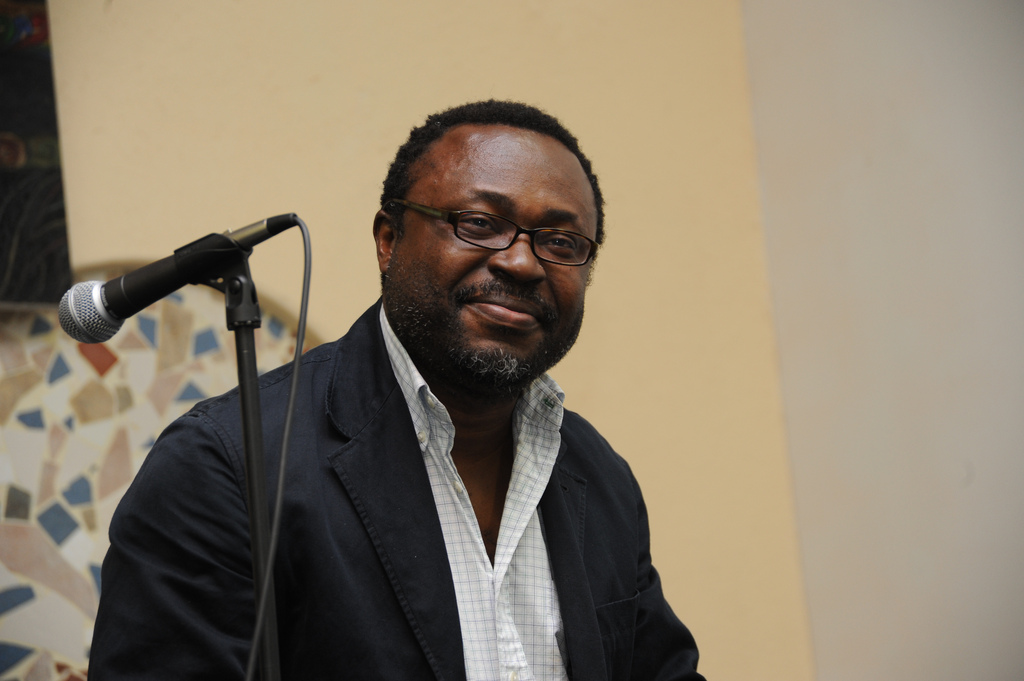
“Obi Nwakanma is one of the Nigerian literary awards winning troika invited by Harvard University to represent New Voices From Nigeria at a recent Africa Events Reading (the other two being Maik Nwosu and Akin Adesokan also featured on this site).

Poet and journalist, he featured at the Poetry International Festival in 1995.

Holder of a BA degree from the University of Jos in Nigeria, Nwakanma was a visiting scholar at one of the pre-eminent universities in Nigeria, UN at Nsukka. Formerly an Assistant Editor at the Sunday Vanguard, he is currently a visiting scholar at The Meeting School, Rindge, NH, where he teaches Literature, Creative Writing and Journalism.”

http://www.poetrysoup.com/biography/obi_nwakanma

“Thirsting for Sunlight, his biography of the tragic modernist poet, Christopher Okigbo, was published by James Currey (UK) in 2010.
His collection of poems, The Horsemen & Other Poems, was published by Africa World Press (New Jersey) in 2007. Nwakanma’s first collection of poems, The Roped Urn, was awarded the Cadbury Prize in 1996 by the Association of Nigerian Authors, and he received the Walter J. Ong Award for Distinguished Achievement in 2008 from Saint Louis University.
His poetry, fiction and essays have appeared in various anthologies and publications including Okike, Vanguard Review, Callaloo, and Wasafiri. His poetry has been translated into Spanish, Dutch, German, and Turkish.
Obi Nwakanma has also worked as a professional journalist, reporting internationally for Newsweek, Neue Zurcher Zeitung, and as Group Literary editor for the Vanguard,one of the major national newspapers in Nigeria, for which he continues to write a weekly column, “The Orbit” in the Sunday Vanguard.
5474688568_2a1f5c5b3b_b He is currently working on a novel, a new collection of poems, and a book on The Mbari Movement, Transnationalism and Modern African Literature.”
In FULL:
ICICLES fall from trees, molten with age, 
without memory - they stand aloof in their 
nakedness - they limber; 
like the gods terrified into silence, 
like tall brooding deities looming out of the 
fog: 

The forest hugs them 
carves them into stones, 
Etches them into the slow 
eastern landscape: rivers, hills 
the slow running water, 
times broken inscapes…

The willows are burdened with ice 
the white shrouds of burial spread 
upon the earth's ravaged face; the eyes 
unseeing, the mouth unspeaking, 
a gust of wind proclaims the anger of 
immemorial ages; the cycle, the 
eternal ritual of mystical returns - 

The cypress - whitening -
boneless; wearing her best habit, 
a pale green in the forest of ghosts -

And so I walk through this windless night 
through the narrow imponderable road 
through the silence - the silence of trees -

I hear not even the gust of wind
I hear only the quiet earth, thawing underneath; 
I hear the slow silent death of winter -

where the sun is yellowest.
 
But above, Monadnock looms 
like some angry Moloch, her 
white nipple seizing the space

drained of all milk.
.
.
 

A she-devil beckoning to worshippers 
seductive - her arm stretching outwards -
to this lonely pilgrim
lost in the mist: 

Behold the school of wild bucks 
Behold the meeting of incarnate 
spirits -
Behold the lost souls bearing tapers 
in rags of rich damask, 
Down Thomas - the saint of 
unbelievers - down the road to bliss 
Down to the red house, uncertain 
like a beggar's bowl hanging unto the cliff 
of withdrawn pledges, where the well is 
deepest.
.
.
 

I have dared to live 
beneath the great untamed.
 

To every good, to every 
flicker of stars along the pine 
shadows; 
To every tussle with lucid dusk, 
To every moonlit pledge, to 
every turn made to outleap 
silvery pollen, 

I have desired to listen - to listen -
to the ripening of seasons.
.
.
.
 

Winter 2001
This is ONE of a continuing sequence.

RIP MC Big Bank Hank- rapper Legend! Sugar Hill Gang.

Rest in Peace, Rappers’ Legend, MC Big Bank Hank, of the legendary Sugar Hill Gang. Aged 58.

I remember “Rapper’s Delight”! (not the misogyny or the homophobia that is in there).

“I said a hip hop,
Hippie to the hippie,
The hip, hip a hop, and you don’t stop, a rock it
To the bang bang boogie, say, up jump the boogie,
To the rhythm of the boogie, the beat.
Now, what you hear is not a test – I’m rappin’ to the beat,
And me, the groove, and my friends are gonna try to move your feet.
See, I am Wonder Mike, and I’d like to say hello,
To the black, to the white, the red and the brown,
The purple and yellow…”

James Weldon Johnson- Black Mammy

Beautiful poem on why care-takers deserve to become permanent residents in Canada (Filipina, Caribbean). Fill in the arguments. By James Weldon Johnson, African-American poet.

THE BLACK MAMMY

O whitened head entwined in turban gay,
O kind black face, O crude, but tender hand,
O foster-mother in whose arms there lay
The race whose sons are masters of the land!
It was thine arms that sheltered in their fold,
It was thine eyes that followed through the length
Of infant days these sons. In times of old
It was thy breast that nourished them to strength.

So often hast thou to thy bosom pressed
The golden head, the face and brow of snow;
So often has it ‘gainst thy broad, dark breast
Lain, set off like a quickened cameo.
Thou simple soul, as cuddling down that babe
With thy sweet croon, so plaintive and so wild,
Came ne’er the thought to thee, swift like a stab,
That it some day might crush thine own black child?

from Fifty Years & Other Poems (1917)


MY CITY- J.W. Johnson

When I come down to sleep death’s endless night,
The threshold of the unknown dark to cross,
What to me then will be the keenest loss,
When this bright world blurs on my fading sight?
Will it be that no more I shall see the trees
Or smell the flowers or hear the singing birds
Or watch the flashing streams or patient herds?
No, I am sure it will be none of these.

But, ah! Manhattan’s sights and sounds, her smells,
Her crowds, her throbbing force, the thrill that comes
From being of her a part, her subtle spells,
Her shining towers, her avenues, her slums–
O God! the stark, unutterable pity,
To be dead, and never again behold my city!

For the love of words. And the freedom to love.

bettsxr-dwayne-betts

Photo by H. Darr Beiser. Photo by Rachel Eliza Griffiths!

About his being locked up as an “adult” as a 16 year old in a men’s prison.

dwayne-betts

Photo by Gesi Schilling.

“For you: anthophilous, lover of flowers”

BY REGINALD DWAYNE BETTS

.
For you: anthophilous, lover of flowers,
green roses, chrysanthemums, lilies: retrophilia,
philocaly, philomath, sarcophilous—all this love,
of the past, of beauty, of knowledge, of flesh; this is
catalogue & counter: philalethist, negrophile, neophile.
A negro man walks down the street, taps Newport
out against a brick wall & stares at you. Love
that: lygophilia, lithophilous. Be amongst stones,
amongst darkness. We are glass house. Philopornist,
philotechnical. Why not worship the demimonde?
Love that—a corner room, whatever is not there,
all the clutter you keep secret. Palaeophile,
ornithophilous: you, antiquarian, pollinated by birds.
All this a way to dream green rose petals on the bed you love;
petrophilous, stigmatophilia: live near rocks, tattoo hurt;
for you topophilia: what place do you love? All these words
for love (for you), all these ways to say believe
in symphily, to say let us live near each other.
.
.
About his being locked up as an “adult” as a 16 year old in a men’s prison.
.
.
Tax cuts mean less time to read, fewer hours of access per month in the prison library- no they can’t go every day. Please.
Your tax cuts take humanity away from other persons.
.
Your tax cuts mean no time for therapy, no time to prepare for the living world, no time to better yourself, no strength to stay away, no better neighbourhood to return to, no vote. No voice.
.
And yes, everyone deserves to be heard, even if you sold coke or weed (that’s what the majority of black men are in prison for) or killed someone or defrauded thousands of people or paid your employees too little. They are people.
.
You have done wrong. Everybody has skeletons. If you’ve done your time, you should be given all your rights back.
.
Anyway.

I am angry for a reason.

In poetry other answers to anger, trying to find some that fit, and enjoying finding new poets, happy with what I find:

Sapphics Against Anger
BY TIMOTHY STEELE
Angered, may I be near a glass of water;
May my first impulse be to think of Silence,
Its deities (who are they? do, in fact, they
Exist? etc.).

May I recall what Aristotle says of
The subject: to give vent to rage is not to
Release it but to be increasingly prone
To its incursions.
[…]

I did not write this poem — in anger. By Joel Dias-Porter

I did not write this poem
in anger,
I did not write this poem
in “Self-Defense.”
I did not write this poem.
Because my pen is empty from
having already written & written this poem.
– Joel Dias-Porter

Minnie Bruce Pratt
Justice, Come Down

[…]
I can smell my anger like sulfur-
struck matches. I wanted what had happened
to be a wall to burn, a window to smash.
At my fist the pieces would sparkle and fall.
All would be changed. I would not be alone. […]

From Violence to Peace
BY JIMMY SANTIAGO BACA

…I drove to Felipe’s house,
anger knotted in me
tight as the rope tied
to the stock trailer
steer strained against.
I pulled, but could not free myself. […]

“Felipe!” I yelled, porch light
flicked on, illuminating the yard.
“Came to fight,” I said, “take off
your glasses.” […]

First shot framed darkness round me
with a spillway of bright light,
eruption of sound, and second shot roared
a spray of brilliance and the third
gave an expanded halo-flash.
My legs woozed, and then
I buckled to the ground.
(I thought, holy shit, what ever happened
to the old yard-style fight between estranged friends!) […]

…During my week in bed,
pellets pollinated me
with a forgotten peace,
and between waking thoughts of anger and vengeance,
sleep was a small meadow of light,
a clearing I walked into and rested. Fragrance of peace
filled me as fragrance
of flowers and dirt permeate hands
that work in the garden all day…

Rita Dove: Fifth Grade Autobiography!

Love love love this poem. Hilarious, touching. but I remember his hands.

Fifth Grade Autobiography

BY RITA DOVE

I was four in this photograph fishing
with my grandparents at a lake in Michigan.
My brother squats in poison ivy.
His Davy Crockett cap
sits squared on his head so the raccoon tail
flounces down the back of his sailor suit.
My grandfather sits to the far right
in a folding chair,
and I know his left hand is on
the tobacco in his pants pocket
because I used to wrap it for him
every Christmas. Grandmother’s hips
bulge from the brush, she’s leaning
into the ice chest, sun through the trees
printing her dress with soft
luminous paws.
I am staring jealously at my brother;
the day before he rode his first horse, alone.
I was strapped in a basket
behind my grandfather.
He smelled of lemons. He’s died—
but I remember his hands.
.
.

James Baldwin- poet!!!

Lord,
            when you send the rain,
            think about it, please,
            a little?
     Do
            not get carried away
            by the sound of falling water,
            the marvelous light
            on the falling water.
        I
            am beneath that water.
            It falls with great force
            and the light
Blinds
            me to the light.
                   — Untitled

America never was America to me, And yet I swear this oath— America will be! Langston Hughes, Ferguson!

 hughes2
A writer dreams.
Let America be America again.
Let it be the dream it used to be.
Let it be the pioneer on the plain
Seeking a home where he himself is free.

(America never was America to me.)

Let America be the dream the dreamers dreamed—
Let it be that great strong land of love
Where never kings connive nor tyrants scheme
That any man be crushed by one above.

(It never was America to me.)

O, let my land be a land where Liberty
Is crowned with no false patriotic wreath,
But opportunity is real, and life is free,
Equality is in the air we breathe.

(There’s never been equality for me,
Nor freedom in this “homeland of the free.”)

Say, who are you that mumbles in the dark? 
And who are you that draws your veil across the stars?

I am the poor white, fooled and pushed apart,
I am the Negro bearing slavery’s scars.
I am the red man driven from the land,
I am the immigrant clutching the hope I seek—
And finding only the same old stupid plan
Of dog eat dog, of mighty crush the weak.

I am the young man, full of strength and hope,
Tangled in that ancient endless chain
Of profit, power, gain, of grab the land!
Of grab the gold! Of grab the ways of satisfying need!
Of work the men! Of take the pay!
Of owning everything for one’s own greed!

I am the farmer, bondsman to the soil.
I am the worker sold to the machine.
I am the Negro, servant to you all.
I am the people, humble, hungry, mean—
Hungry yet today despite the dream.
Beaten yet today—O, Pioneers!
I am the man who never got ahead,
The poorest worker bartered through the years.

Yet I’m the one who dreamt our basic dream
In the Old World while still a serf of kings,
Who dreamt a dream so strong, so brave, so true,
That even yet its mighty daring sings
In every brick and stone, in every furrow turned
That’s made America the land it has become.
O, I’m the man who sailed those early seas
In search of what I meant to be my home—
For I’m the one who left dark Ireland’s shore,
And Poland’s plain, and England’s grassy lea,
And torn from Black Africa’s strand I came
To build a “homeland of the free.”

The free?

Who said the free?  Not me?
Surely not me?  The millions on relief today?
The millions shot down when we strike?
The millions who have nothing for our pay?
For all the dreams we’ve dreamed
And all the songs we’ve sung
And all the hopes we’ve held
And all the flags we’ve hung,
The millions who have nothing for our pay—
Except the dream that’s almost dead today.

O, let America be America again—
The land that never has been yet—
And yet must be—the land where every man is free.
The land that’s mine—the poor man’s, Indian’s, Negro’s, ME—
Who made America,
Whose sweat and blood, whose faith and pain,
Whose hand at the foundry, whose plow in the rain,
Must bring back our mighty dream again.

Sure, call me any ugly name you choose—
The steel of freedom does not stain.
From those who live like leeches on the people’s lives,
We must take back our land again,
America!

O, yes,
I say it plain,
America never was America to me,
And yet I swear this oath—
America will be!

Out of the rack and ruin of our gangster death,
The rape and rot of graft, and stealth, and lies,
We, the people, must redeem
The land, the mines, the plants, the rivers.
The mountains and the endless plain—
All, all the stretch of these great green states—
And make America again!

Lula Lowe Weeden- Black Poet full of surprises and twists!

Do you know of the poet Lula Lowe Weeden? She is amazing and has these surprises in her poems!

“Robin Red Breast”

Little Robin red breast,
I hear you sing your song.
I would love to have you put it into my little cage,
Into my little mouth.

“Dance”

Down at the hall at midnight sometimes,
You hear them singing rhymes.
These girls are dancing with boys.
They are too big for toys.

From “Caroling Dusk: an Anthology of Verse by Black Poets.” Edited by Countee Cullen.

NEW and USED: http://www.abebooks.com/servlet/BookDetailsPL?bi=12331091523

Black History- Poems about The Body. Calvin Forbes, “Picture of a Man”

Image

Poems about The Body. Calvin Forbes, Black poet- “Picture of a Man”

He draws a man,
bright swirls of red.
And I say give me a tree.
He points to the middle
of his red and says
“there’s a tree!”
Tonight without complaining
he goes off to sleep
asking why in his story book
the big boats have little
boats. He shouts
goodnight: I ask if he wants
the lights out-

he says no, that he can’t see
without the light.
A different excuse than
last night when he was plain scared.
Later I turn off the light-
his face soft as a breast.
And I know then what another man
meant when he said
maybe I could have loved
better
but couldn’t have loved more.
I thought of a woman like that once.
This child is all I have left…

—–

BUY:
USED: http://www.abebooks.com/servlet/SearchResults?an=calvin+forbes&kn=poetry&sts=t
NEW: http://www.indiebound.org/book/9780807126660

http://www.poetryfoundation.org/bio/calvin-forbes

“Calvin Forbes teaches writing, literature, and jazz history at the School of the Art Institute in Chicago. Blues and jazz inform both the rhythm and content of his poetry. He often uses ballads to tell family stories or the ups and downs of romance. But Forbes updates the tradition with surreal techniques, epigrammatic humor, and changing voices. He described his work as “simplicity shacked up with complexity.” His first book, Blue Monday, appeared in 1974 and his most recent, The Shine Poems, a book that resurrects the African-American folk character, was issued in 2001.”Image

Black History- poems about your body. Waring Cuney- No images.

Image

Black History Month- poems about your body.

She does not know
her beauty,
she thinks her brown body
has no glory.

If she could dance
naked
under palm trees
and see her image in the river,
she would know.

But there are no palm trees
on the street,
and dish water gives back
no images.

Waring Cuney- No images.

“He is best known for his poem “No Images”, which won first prize in the 1926 Opportunity poetry contest. The poem was later used by jazz singer/pianist/songwriter Nina Simone on her 1966 album Let It All Out.”

“William Waring Cuney, “No images” from Storefront Church, published in 1973 by Paul Breman Limited. After exhaustive efforts have been made to identify and contact a rights holder, this material is believed to be in the public domain.”

http://www.youtube.com/watch?v=u6vZwsJu7co

http://www.poetryfoundation.org/bio/william-waring-cuney

http://www.aaregistry.org/historic_events/view/waring-cuney-poet-harlem-rennissance


“He is the consummate artist when it comes to drawing vivid sketches of character with brevity and clarity of words. Cuney, as he was better known among his contemporaries, is often referred to either as one of the minor poets of the Harlem Renaissance or one of the “second echelon” poets of the New Negro Movement. However, among his contemporaries he was considered one of the favorites of the Renaissance group.”


The Tropics of New York by Claude McKay in 2014 Black History Month’s last days.

Image

For love of all hot dusty roads, and our childhood memories, The Tropics of New York by Claude McKay in 2014 Black History Month’s last days. Thinking of Jamaica.

Bananas ripe and green, and ginger root
Cocoa in pods and alligator pears,
And tangerines and mangoes and grape fruit,
Fit for the highest prize at parish fairs,

Sat in the window, bringing memories
of fruit-trees laden by low-singing rills,
And dewy dawns, and mystical skies
In benediction over nun-like hills.

My eyes grow dim, and I could no more gaze;
A wave of longing through my body swept,
And, hungry for the old, familiar ways
I turned aside and bowed my head and wept.