The international Day to End Violence Against Sex Workers!

REv-Sweat-russian-doll_1150-2

Lovely poetry by or about sex workers! The International Day to End Violence Against Sex Workers is upon us! Yay!

By Su Xiaoxiao: a famous Chinese courtesan and poet, so beautiful poems were written about her for over 1500 years! Courtesans were trained as singers, dancers and poets in China. Haven’t found sex positive poems by english speakers yet.

Song of the Same Heartbeat:

I ride in a decorated carriage,
My darling rides a blue-white horse.
Where should we tie the knot for our heart?
Under the pine and cypress trees of Xiling.
.
By the later courtesan Liu Xiaoqing.
.
The carriage rumbles through the fragrent herbs of Xiling,
A message arrived from the inner quarters, inviting me to an outing.
I shed a cup of wine by myself on Su Xiaoxiao’s tomb,
Do you know that I am the one with the same feelings as you?
.
.
By Basho
.
Under the same roof
play girls were sleeping
bush clover and the moon
.
— His heart is touched by the soft light and the companionship. The Japanese had a number of names for sex workers. In this Haiku both intimacy and distance.
.
.
By Shiki
.
Lighting the lamps,
One shadow is for each
of the dolls
.
— The sex workers have each other, live in a house together and there is someone who cares for them and lights the lamps. One shadow means that they are each a person. He knows them, even if he can only see them when he takes care of them, even if they are too precious and high status for him to personally know.

Dolls had great status and import. Dolls were crafted for “household shrines, for formal gift-giving, or for festival celebrations such as Hinamatsuri, the doll festival.” Pilgrims would buy them as a memory of a temple visit or a journey.


Black poet Claude McKay writes about sex workers in Harlem, part of the poem shows McKay’s empathy.
You can read it as a wish to make life safer and better for sex workers doing their work.

I hear the halting footsteps of a lass
In Negro Harlem when the night lets fall
Its veil. I see the shapes of girls who pass
To bend and barter at desire’s call.
Ah, little dark girls who in slippered feet
Go prowling through the night from street to street!

Through the long night until the silver break
Of day the little gray feet know no rest;
Through the lone night until the last snowflake
Has dropped from heaven upon the earth’s white breast,
The dusky, half-clad girls of tired feet
Are trudging, thinly shod, from street to street.

[…]
Ah, heart of me, the weary, weary feet
In Harlem wandering from street to street.

Robert Frost (1874–1963). Mountain Interval. 1920.

jersey_orchard_jm

Robert Frost (1874–1963).  Mountain Interval.  1920.

15. The Cow in Apple Time

SOMETHING inspires the only cow of late
To make no more of a wall than an open gate,
And think no more of wall-builders than fools.
Her face is flecked with pomace and she drools
A cider syrup. Having tasted fruit, 5
She scores a pasture withering to the root.
She runs from tree to tree where lie and sweeten
The windfalls spiked with stubble and worm-eaten.
She leaves them bitten when she has to fly.
[…]

Velden

On peaceful fields‘(1950) by Andrei Mylnikov,  State Russian Museum in Saint Petersburg.

14. A Time to Talk

WHEN a friend calls to me from the road
And slows his horse to a meaning walk,
I don’t stand still and look around
On all the hills I haven’t hoed,
And shout from where I am, What is it?
No, not as there is a time to talk.
I thrust my hoe in the mellow ground,
Blade-end up and five feet tall,
And plod: I go up to the stone wall
For a friendly visit.


Dust of Snow

The way a crow
Shook down on me
The dust of snow
From a hemlock tree
Has given my heart
A change of mood
[…]

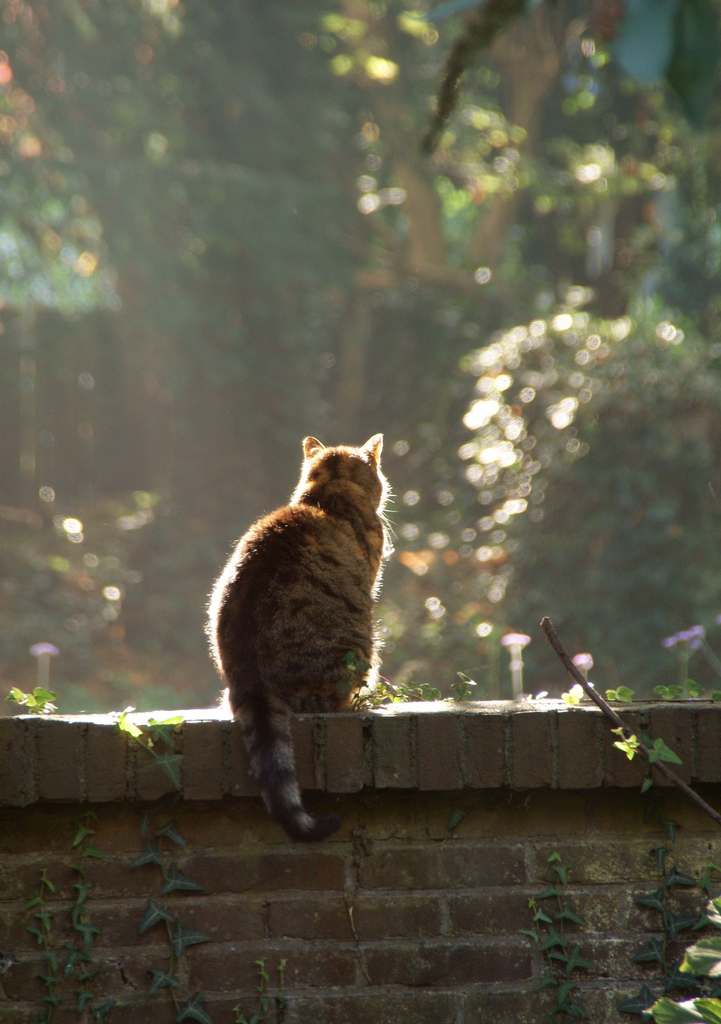
Swiss-Italian poetry by Alberto Nessi and Giorgio Orelli. Cat and pouring rains!

2892421591_25389d1ecb_b

Photo: Lambert Wolterbeek Muller, Utrecht, the Netherlands.

Italian poetry by Alberto Nessi and Giorgio Orelli. Peta italiano

Two poems for the cat by Alberto Nessi.

The Disappearance

Little is left from her life: the the wall boards
scratched by her claws, her ghost that visits us
every night when we think we spot her in the geraniums, the stories
of her adventures among the cacti
pirouetting, pouncing, dancing with the flies
the rivalry with the other cats we’d shoo away
as if she was of a higher feline race
and not a just a gentle moggie. Only traces and ghosts
of life remain
A cat like her
someone has poisoned her on purpose
or some peasant skinned and ate her —
but what if she ran away from home, a young girl looking for love
and what if we saw her again tomorrow, standing still
in the middle of the patio
protecting our equally precarious lives?

[…cat returns…]

“due poesie per la gatta La scomparsa della sua vita è rimasto poco: il pannello di pavatex graffiato dalle…”

In autumn by Giorgio Orelli.

Catlike in the salamander’s
slimy yellow
between the hedge and the tarmac: I didn’t even
see the face of the boy who
almost ran over me at the bend with his bike.
The rain was hosing down sideways
so much that it darkened the mood of the cows
near the high school:
in groups, dazed,
they forsook the grass,
and lowed miserably at the sky.

(Outlines, 1989)

D’autunno

Felinamente in giallo
viscido di salamandra
tra siepe e asfalto: neanche la faccia
gli ho visto al ragazzo che in bici
quasi m’investe allo svolto.
Tanto fitto pioveva e di traverso
che alle vacche vicino al liceo
l’anima s’annegrava:
in gruppo, stralunate,
disprezzavano l’erba,
mute muggivano al cielo.

(Spiracoli, 1989)

“Poetry Editor’s note: Contrappasso bids a sad farewell to Giorgio Orelli, who passed away […] at the age of 92. Below are the five poems of Orelli’s that appeared in Issue 3, translated by Marco Sonzogni.”

You created the night, I created the lamp. Iqbal!

Mount-Everest-2
www.pakistantoday.com.pk

You created the night, I created the lamp
You created clay and I made the pottery
You created the deserts, the mountains and jungles
And I produced the rice fields, the gardens and the orchards
It was I who turned rock into mirrors
And poison into cures

Iqbal

“…one blue-colored cloak, I had considered to be the sky”

Iqbal

Iqbal was born in 1877 in what is now Pakistan: the Punjab Province of British India. From a Brahmin family converted to Islam, he studied in Cambridge, became a lawyer, did his phd in Germany and wrote poetry in Persian and Urdu. He was a favourite of the Iranian revolution in 1979 and stood at the birth of the nation of Pakistan.

Sadjat Buat Adik- poem for my little brother, by Rivai Apin

Poem for my little brother
 .
Ever shorter the day
Fingers unbendable chilled by the evening
Fingers exhausted by searching for form
 .
There is always
The singing of a dream dreamt, one you will hear at last
You should
Let the light at dusk meet the light of day
and carefully attend to that
 .
Tomorrow is another day
And it will keep getting shorter


This modernist poet died in poverty and obscurity in 1995 in Jakarta. Political prisoner.

Political prisoner on Buru island with Indonesian writers, journalists, playwrights and poets. Tens of thousands of left-leaning and progressive Indonesians for periods up to 14 years.

Apin was one of the very few who managed to write something during his imprisonment. Memoirs: Jiku Kecil (19971-1973) about his unit and a couple of poems (1974-1979).

Many died in these prison camps. I don’t know enough to say whether they can be more closely described as how we understand concentration camps. Some combination of death, hunger, humiliation, reform and punishment.


Dutch translated by Linde Voûte
Gedicht voor mijn broertje

Steeds korter de dag
Vingers onbuigzaam verkild door de avond
Vingers vermoeid door het vinden van vorm
 .
Er is altijd nog
Het zingen van voorbije droom dat je eens zult horen
Je zou
Schemerlicht de dag moeten laten ontmoeten
en oplettend toezien
 .
Morgen is er weer een dag
Maar hij wordt steeds korter
 .
Uit: Ik wil nog duizend jaar leven. Negen moderne Indonesische dichters. Meulenhoff, Amsterdam,1979. Poetry International Serie. Put together by Harry Aveling.
.
BUY:
ONE book left in the Netherlands, antique and with nice prints: http://www.bol.com/nl/p/ik-wil-nog-duizend-jaar-leven/1001004005110174/
.
 .

More moons haiku. Winter Solstice moon. Spring moon.

I shift my pillow
closer to the
full moon.

Saiba 1858 (Tr. Hoffmann)

Winter seclusion;
listening, that evening,
to rain in the mountains

Moon, plum blossoms,
this, that,
and the day goes.

Issa

Sitting all alone
facing a still white paper:
behind me the moon

An evening guest—
the girl flings open a window
in comes the moon

The clouds hide the moon—
nursing her twins a mother
in the thick darkness.

Vasile Moldovan

Celebration time: black poets!!

All day Poetry by Black or African poets. Celebration time.

1.
When God
created
the black child
He was
showing off.

“Black Cryptogram” for Sterling A. Brown by Michael S. Harper
.
.

2 . Tall as a Cypress (abr).

I am a black woman
tall as a cypress
strong
beyond all definition still
defying place
and time
and circumstance
assailed
impervious
indestructible
Look
on me and be
renewed

Mari Evans
.
.

3. Poem about my Rights (abr)

alone on the streets/alone not being the point/
the point being that I can’t do what I want
to do with my own body because I am the wrong
sex the wrong age the wrong skin and
suppose it was not here in the city but down on the beach/
or far into the woods and I wanted to go
there by myself thinking about God/or thinking
about children or thinking about the world/all of it
disclosed by the stars and the silence:
I could not go and I could not think and I could not
stay there
alone
as I need to be
alone because I can’t do what I want to do with my own
body and
who in the hell set things up
like this
[…]
I am not wrong: Wrong is not my name
My name is my own my own my own
and I can’t tell you who the hell set things up like this
but I can tell you that from now on my resistance
my simple and daily and nightly self-determination
may very well cost you your life

June Jordan. “Poem about my rights”

KOKUMỌ: Lucille Clifton. Grandsons!!

CLIFTON_resized

KOKUMỌ

Photographs, my grandsons spinning in their joy.

universe
keep them turning —turning
black blurs against the window
of the world
for they are beautiful
and there is trouble coming
round and round and round

Lucille Clifton
In: the Oxford Anthology of African-American Poetry.
Ed. Arnold Rampersad; Associate Ed. Hilary Herbold.


BUY the book:

USED: http://www.abebooks.com/servlet/SearchResults?sts=t&tn=oxford+anthology+of+african-american+poetry
NEW from a local bookstore: http://www.indiebound.org/book/9780195125634

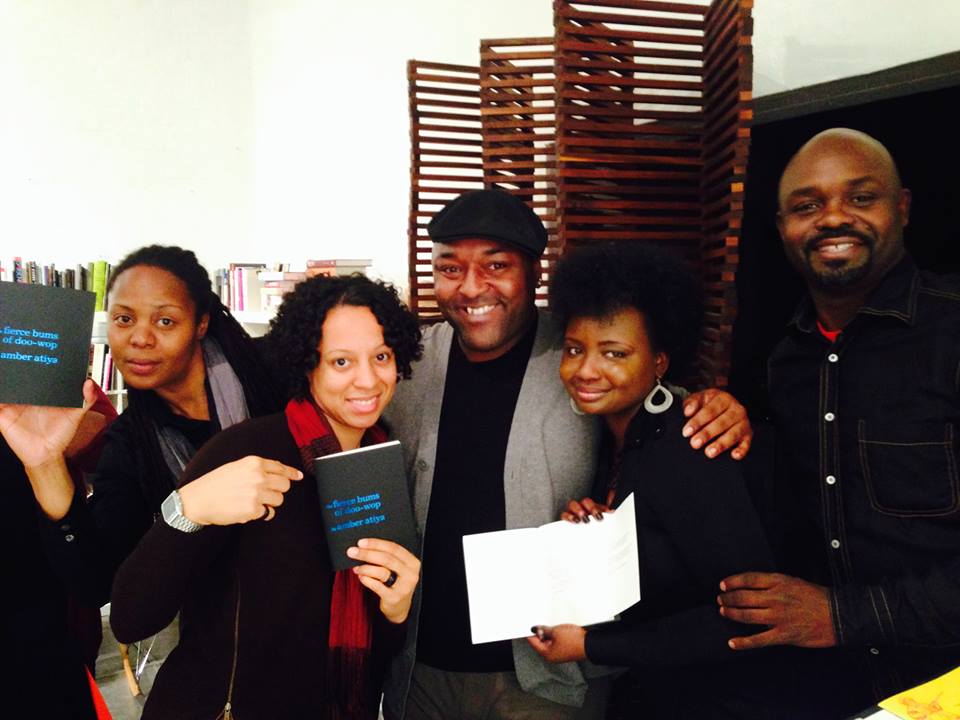
If my slumlord allowed pets- Amber Atiya

tumblr_nedo53sYwC1teummlo1_1280

Second from right. Photo at http://amberatiya.tumblr.com


if my slumlord allowed pets

i’d adopt every
after hour paw
mauled in battle

trimmed with scabs
toppling trash
for fries & wing tips

fur splattered
with egg foo young

these streets
weren’t paved
for tenderness

a tabby’s pregnant belly
low-hanging
as a rain cloud

a swollen nimbus
grazing the ground

by Amber Atiya
.
.
.
‪#‎BlackVoicesMatter‬
‪#‎BlackPoetsFTW‬
‪#‎GeniusBlackAmerica‬

http://www.poetshouse.org/programs-and-events/workshops-classes-residencies/emerging-poets-residency/amber-atiya

Amber Atiya, a queer poet and native Brooklynite, has performed at the Nuyorican Poets Café, Theater for the New City, Westbeth Center for the Arts, and many elsewheres. Her poems have been published in Tribes MagazineDrunken Boat, and Coloring Book, an anthology of multicultural writers. She is a member of a women’s writing group, with whom she’s been writing for ten years and counting.

From: Citizen by Claudia Rankine

Rankine-Claudia-hr
Image Credit: CSU Fullerton
 .
 .
 .
CLAUDIA RANKINE co-edited the anthology American Women Poets in the 21st Century: Where Lyric Meets Language, and her work is included in several anthologies, including Great American Prose Poems: From Poe to the Present, Best American Poetry 2001, Giant Step: African American Writing at the Crossroads of the Century, and The Garden Thrives: Twentieth Century African-American Poetry. Her work has been published in numerous journals including Boston Review, TriQuarterly, and The Poetry Project Newsletter. She lives and teaches in California. She is the Holloway/Mixed Blood poet for the spring series.
 .
 .
You are in the dark, in the car, watching the black-tarred street being swallowed by speed; he tells you his dean is making him hire a person of color when there are so many great writers out there.
/
You think maybe this is an experiment and you are being tested or retroactively insulted or you have done something that communicates this is an okay conversation to be having.
Why do you feel okay saying this to me? You wish the light would turn red or a police siren would go off so you could slam on the brakes, slam into the car ahead of you, be propelled forward so quickly both your faces would suddenly be exposed to the wind.
/
As usual you drive straight through the moment with the expected backing off of what was previously said. It is not only that confrontation is headache producing; it is also that you have a destination that doesn’t include acting like this moment isn’t inhabitable, hasn’t happened before, and the before isn’t part of the now as the night darkens 
and the time shortens between where we are and where we are going.
/
When you arrive in your driveway and turn off the car, you remain behind the wheel another ten minutes. You fear the night is being locked in and coded on a cellular level and want time to function as a power wash. Sitting there staring at the closed garage door you are reminded that a friend once told you there exists a medical term — John Henryism — for people exposed to stresses stemming from racism. They achieve themselves to death trying to dodge the build up of erasure. Sherman James, the researcher who came up with the term, claimed the physiological costs were high. You hope by sitting in 
silence you are bucking the trend.
/
When the stranger asks, Why do you care? you just stand there staring at him. He has just referred to the boisterous teenagers in Starbucks as niggers. Hey, I am standing right here, you responded, not necessarily expecting him to turn to you.
He is holding the lidded paper cup in one hand and a small paper bag in the other. They are just being kids. Come on, no need to get all KKK on them, you say.
Now there you go, he responds.
The people around you have turned away from their screens. The teenagers are on pause. There I go? you ask, feeling irritation begin to rain down. Yes, and something about hearing yourself repeating this stranger’s accusation in a voice usually reserved for your partner makes you smile.
/
A man knocked over her son in the subway. You feel your own body wince. He’s okay, but the son of a bitch kept walking. She says she grabbed the stranger’s arm and told him to apologize: I told him to look at the boy and apologize. And yes, you want it to stop, you want the black child pushed to the ground to be seen, to be helped to his feet and be brushed off, not brushed off  by the person that did not see him, has never seen him, has perhaps never seen anyone who is not a reflection of himself.
The beautiful thing is that a group of men began to stand behind me like a fleet of  bodyguards, she says, like newly found uncles and brothers.
/
The new therapist specializes in trauma counseling. You have only ever spoken on the phone. Her house has a side gate that leads to a back entrance she uses for patients. You walk down a path bordered on both sides with deer grass and rosemary to the gate, which turns out to be locked.
At the front door the bell is a small round disc that you press firmly. When the door finally opens, the woman standing there yells, at the top of her lungs, Get away from my house. What are you doing in my yard?
It’s as if a wounded Doberman pinscher or a German shepherd has gained the power of speech. And though you back up a few steps, you manage to tell her you have an appointment. You have an appointment? she spits back. Then she pauses. Everything pauses. Oh, she says, followed by, oh, yes, that’s right. I am sorry.
I am so sorry, so, so sorry.
/
.
 .
 .

BUY!
USED: http://www.abebooks.com/servlet/SearchResults?sts=t&tn=American+Women+Poets+in+the+21st+Century%3A+Where+Lyric+Meets+Language&x=0&y=0
NEW from Independent bookstores: http://www.indiebound.org/book/9780819565471

Charles Bukowski on a white cross-eyed tailless cat

The History Of One Tough Motherfucker. When poetry is just the best thing ever… The final word on cross-eyed,
shot, runover de-tailed cats. The only words probably because most people would not write about cats that have come back from the dead. I should take a look before I state that so positively of course: for all I know there is a cannon of poetry on this range of cats.

By Charles Bukowski

he came to the door one night wet thin beaten and
terrorized
a white cross-eyed tailless cat
I took him in and fed him and he stayed
grew to trust me until a friend drove up the driveway
and ran him over

I took what was left to a vet who said,”not much
chance…give him these pills…his backbone
is crushed, but is was crushed before and somehow
mended, if he lives he’ll never walk, look at
these x-rays, he’s been shot, look here, the pellets
are still there…also, he once had a tail, somebody
cut it off…”

I took the cat back, it was a hot summer, one of the
hottest in decades, I put him on the bathroom
floor, gave him water and pills, he wouldn’t eat, he
wouldn’t touch the water, I dipped my finger into it
and wet his mouth and I talked to him, I didn’t go any-
where, I put in a lot of bathroom time and talked to
him and gently touched him and he looked back at
me with those pale blue crossed eyes and as the days went
by he made his first move
dragging himself forward by his front legs
(the rear ones wouldn’t work)
he made it to the litter box
crawled over and in,
it was like the trumpet of possible victory
blowing in that bathroom and into the city, I
related to that cat-I’d had it bad, not that
bad but bad enough

one morning he got up, stood up, fell back down and
just looked at me.
“you can make it,” I said to him.
he kept trying, getting up falling down, finally
he walked a few steps, he was like a drunk, the
rear legs just didn’t want to do it and he fell again, rested,
then got up.

you know the rest: now he’s better than ever, cross-eyed
almost toothless, but the grace is back, and that look in
his eyes never left…
and now sometimes I’m interviewed, they want to hear about
life and literature and I get drunk and hold up my cross-eyed,
shot, runover de-tailed cat and I say,”look, look
at this!”
but they don’t understand, they say something like,”you
say you’ve been influenced by Celine?”
“no,” I hold the cat up,”by what happens, by
things like this, by this, by this!”
I shake the cat, hold him up in
the smoky and drunken light, he’s relaxed he knows…
it’s then that the interviews end
although I am proud sometimes when I see the pictures
later and there I am and there is the cat and we are photo-
graphed together.
he too knows it’s bullshit but that somehow it all helps.

Black History Month- British black poet Shamshad Khan “High Time.”

Black History Month- British black poet Shamshad Khan:

“High Time”

Black elephants 
jazz dancing
gold and red
grin
i imagine
they wave
as they pass the window
of my third floor flat
just in case they are
i wave back


The Fire People: Collection of Contemporary Black British Poets
NEW and USED: Abebooks.com The Fire People

When you long for warmth… Poems about fire – I

When you are old- William Butler Yeats
WHEN you are old and gray and full of sleep 
And nodding by the fire, take down this book, 
And slowly read, and dream of the soft look 
Your eyes had once, and of their shadows deep; 

How many loved your moments of glad grace, 
And loved your beauty with love false or true; 
But one man loved the pilgrim soul in you, 
And loved the sorrows of your changing face.
 
And bending down beside the glowing bars, 
Murmur, a little sadly, how love fled 
And paced upon the mountains overhead, 
And hid his face amid a crowd of stars.


Burning Drift- John Greenleaf Whittier

Before my drift-wood fire I sit, 
And see, with every piece I burn, 
Old dreams and fancies coloring it, 
And folly's unlaid ghosts return.
... 
O ships of mine, whose swift keels cleft 
The enchanted sea on which they sailed,
...
Did I not watch from them the light 
Of sunset on my towers in Spain,
...
Did sudden lift of fog reveal 
...
Have I not drifted hard upon 
...
Did land winds blow from jasmine flowers, 
...
And find in Bagdad's moonlit street, 
Haroun al Raschid walking yet
...
Dear souls who left us lonely here, 
Bound on their last, long voyage, to whom 
We, day by day, are drawing near, 
Where every bark has sailing room.
I know the solemn monotone 
Of waters calling unto me; 
I know from whence the airs have blown 
That whisper of the Eternal Sea.
 

As low my fires of drift-wood burn, 
I hear that sea's deep sounds increase, 
And, fair in sunset light, discern 
Its mirage-lifted Isles of Peace.


Shelley- To a sky lark

Higher still and higher 
From the earth thou springest, 
Like a cloud of fire 
The blue deep thou wingest, 
And singing still dost soar, and soaring ever singest.
 10 

In the golden lightning 
Of the sunken sun, 
O'er which clouds are bright'ning, 
Thou dost float and run, 
Like an unbodied joy whose race is just begun.
 15 

The pale purple even 
Melts around thy flight; 
Like a star of heaven 
In the broad daylight, 
Thou art unseen, but yet I hear thy shrill delight¡ 20 

Basho, Takako and the moon!

Exciting! Full Beaver moon tonight!! Full. Beaver. Moon.

Beaver and Moon! Moon beaver beaver moon. It sounds good. Here are some haikus. First 5 by Basho -who was gay!

This bright harvest moon  
keeps me walking all night long
around the little pond 

occasional clouds
one gets a rest
from moon-viewing

the setting moon
the thing that remains
four corners of his desk

a peasant’s child
husking rice, pauses
to look at the moon

Autumn full moon,
the tides slosh and foam
coming in

Takako:

the disk moon
the disk frozen lake
reflecting each other

Haikus about quiet.

Standing still at dusk
Listen…In far distances
The song of froglings!

Meaning: Dusk is the period where boundaries disappear, and before the light of the stars emphasizes the darks and the lights. Wandering around at dusk is disappearing yourself into everything around you. You can focus on sound. Sounds from afar seem close by. Songs are carried far. Froglings who feel safe sing to each other and by the grace of dusk you are part of their audience, of other froglings. Dusk calls in the loneliness and the loneliness is eased by the froglings who are far and seem close. Doesn’t really matter that they are far. Dusk is when the flowers open and their scent comes towards us.


Buson

If you were silent
Flight of warblers on dark sky
Oh! Autumn snowflakes!

Sokan

Come come! Come out!
On pebble roads worn tires fade-in the dark
And look… the stars

Come come! Come Out!
From bogs old frogs command the dark
and look…the stars”
― Kikaku,