The Black Unicorn, Audre Lorde.

Migraine morning, so no reading law but reading poetry.

The Black Unicorn

The black unicorn is greedy.
The black unicorn is impatient.
The black unicorn was mistaken
for a shadow or symbol
and taken
through a cold country
where mist painted mockeries
of my fury.
It is not on her lap where the horn rests
but deep in her moonpit
growing.
The black unicorn is restless
the black unicorn is unrelenting
the black unicorn is not
free.

NEW and USED: Abebooks.com The Oxford Anthology of African-American Poetry
NEW at independent bookstores: http://www.indiebound.org/book/9780195125634

The Black Unicorn isn’t supposed to be funny, but she makes me smile. I’m not sure: I think the mist means that a token black person is white washed by white friends or fellow academics, writers maybe, a place where she feels bound also by misogyny and emphasizes her power comes from her vag. That’s what I read into it. The black unicorn is powerful.

Quick notes about the poem.

The Night is beautiful, So the faces of my people. Langston Hughes.

The film Selma was heart-aching. One of the most beautiful shots was where Dr. King phones Mahalia Jackson and asks to hear the voice of the Lord and she sings to him My Precious Lord. 

Listen to the song hhttps://www.youtube.com/watch?v=N1ceCpU25vA

My people

 
The night is beautiful,
So the faces of my people.

The stars are beautiful,
So the eyes of my people.

Beautiful, also is the sun.
Beautiful, also, are the souls of my people.

NEW and USED: http://www.abebooks.com/servlet/SearchResults?sts=t&tn=oxford+anthology+of+african-american+poetry
NEW at independent bookstores: http://www.indiebound.org/book/9780195125634
.
.

“Been a train crash… An black man didn drive? No. Black man didn drive”.

James Berry (OBE, 1924-) From Jamaica to the UK!

Two Black Labourers on a London Building Site

Been a train crash.
.   Wha?
Yeh — tube crash.
.   Who the driver?
Not a black man.
.   Not a black man?
I check that firs.
.   Thank Almighty God.
Bout thirty people dead.
.   Thirty people dead?
Looks maybe more.
.   Maybe more?
Maybe more.
.   An black man didn drive?
No. Black man didn drive.
.

.

A Story I am in: Selected Poems by James Berry:
NEW and USED: http://www.abebooks.co.uk/servlet/BookDetailsPL?bi=12538913206

From: London a History in Verse, ed by Mark Ford.
NEW: http://www.localbookshops.co.uk
USED: http://www.abebooks.com/servlet/BookDetailsPL?bi=9186279941

From Wiki with thanks:

Selected publications

  • Bluefoot Traveller: An Anthology of Westindian Poets in Britain (editor), London: Limestone Publications, 1976; revised edition Bluefoot Traveller: Poetry by West Indians in Britain, London: Harrap, 1981
  • Fractured Circles (poetry), London: New Beacon Books, 1979
  • Lucy’s Letters and Loving, London: New Beacon Books, (1982)
  • News for Babylon: The Chatto Book of Westindian-British Poetry (editor), London: Chatto & Windus, 1984
  • Chain of DaysOxford University Press, 1985
  • A Thief in the Village and other stories (for children), London: Hamish Hamilton, 1987
  • The Girls and Yanga Marshall: four stories (for children), London: Longman, 1987
  • Anancy-Spiderman: 20 Caribbean Folk Tales (for children), illustrated by Joseph Olubo, London: Walker, 1988
  • When I Dance (for children), Hamish Hamilton, 1988
  • Isn’t My Name Magical? (for children), Longman/BBC, 1990
  • The Future-Telling Lady and other stories (for children), London: Hamish Hamilton, 1991
  • Ajeemah and his Son (for children), USA: HarperCollins, 1992
  • Celebration Song (for children), London: Hamish Hamilton, 1994
  • Classic Poems to Read Aloud (editor), London: Kingfisher, 1995
  • Hot Earth Cold EarthBloodaxe Books, 1995
  • Playing a Dazzler (for children), London: Hamish Hamilton, 1996
  • Don’t Leave an Elephant to Go and Chase a Bird (for children), USA: Simon & Schuster, 1996
  • Everywhere Faces Everywhere (for children), Simon and Schuster, 1997
  • First Palm Trees (for children), illustrated by Greg Couch, Simon & Schuster, 1997
  • Around the World in 80 Poems (editor – for children), London: Macmillan, 2001
  • A Nest full of Stars (for children), London: Macmillan, 2002
  • Only One of Me (selected poems – for children), London: Macmillan, 2004
  • James Berry Reading from his poems for children, CD, The Poetry Archive, 2005
  • Windrush SongsBloodaxe Books, 2007
  • A Story I Am In: Selected Poems, Bloodaxe Books, 2011

Awards

Chilling Out Beside the Thames- John Agard, black British poet.

What I did in the London month. Too. I love the humour of Agard talking about the little pidgeon looking on, Anansi the spider and the church’s promises on English ground. Ending with the day’s little pleasure strawberry.

Summer come, mi chill-out beside the Thames.
Spend a little time with weeping willow.
Check if den Trafalgar pidgeon still salute
old one-eyed one-armed Lord Horatio.

Mi treat gaze to Gothic cathedral
Yet me chant forget how spider spiral
Is ladder aspiring to eternal truth…
Trickster Nansi spinning from Shakespeare sky.

Sudden so, mi decide to play tourist.
Tower of London high-up mi list.
Who show up but Anne Boleyn with no head on
And headless Ralegh gazing towards Devon.

Jesus lawd, history shadow so bloody.
A-time for summer break with strawberry.

.

Cool video of the editor chatting about finding the poems! https://www.youtube.com/watch?v=0qz4m6AVONE

Agard is Afro-Guyanese, Jamaican and British.

USED: http://www.abebooks.com/servlet/BookDetailsPL?bi=13869647203
NEW: http://www.indiebound.org/book/9781852247331

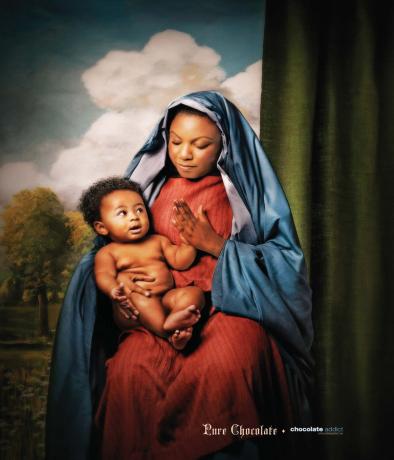
Little Brown Baby by Paul Laurence Dunbar

black-baby-jesus
Photo: Matt Barnes Art direction: Natasha Romanelli, Ann Aberin

* For parents and others who love the adorableness of scallywags.
* I love how people squoosh language.
* Sometimes I look at old old poems and I feel amazing that words change and grammar too. It is pretty fantastic. “hebban olla vogala nestas bagunnan hinase hic enda thu wat unbidan we nu” Old (west) Dutch/old Kentish used to be very similar!!

Little Brown Baby
BY PAUL LAURENCE DUNBAR

Little brown baby wif spa’klin’ eyes,
Come to yo’ pappy an’ set on his knee.
What you been doin’, suh — makin’ san’ pies?
Look at dat bib — you’s es du’ty ez me.
Look at dat mouf — dat’s merlasses, I bet;
Come hyeah, Maria, an’ wipe off his han’s.
Bees gwine to ketch you an’ eat you up yit,
Bein’ so sticky an sweet — goodness lan’s!

Little brown baby wif spa’klin’ eyes,
Who’s pappy’s darlin’ an’ who’s pappy’s chile?
Who is it all de day nevah once tries
Fu’ to be cross, er once loses dat smile?
Whah did you git dem teef? My, you’s a scamp!
Whah did dat dimple come f’om in yo’ chin?
Pappy do’ know you — I b’lieves you’s a tramp;
Mammy, dis hyeah’s some ol’ straggler got in!

Let’s th’ow him outen de do’ in de san’,
We do’ want stragglers a-layin’ ‘roun’ hyeah;
Let’s gin him ‘way to de big buggah-man;
I know he’s hidin’ erroun’ hyeah right neah.
Buggah-man, buggah-man, come in de do’,
Hyeah’s a bad boy you kin have fu’ to eat.
Mammy an’ pappy do’ want him no mo’,
Swaller him down f’om his haid to his feet!

Dah, now, I t’ought dat you’d hug me up close.
Go back, ol’ buggah, you sha’n’t have dis boy.
He ain’t no tramp, ner no straggler, of co’se;
He’s pappy’s pa’dner an’ play-mate an’ joy.
Come to you’ pallet now — go to yo’ res’;
Wisht you could allus know ease an’ cleah skies;
Wisht you could stay jes’ a chile on my breas’—
Little brown baby wif spa’klin’ eyes!

The Creation: “And God stepped out on space…” by James Weldon Johnson! Pretty fantastic.

RE-imagined poem by James Weldon Johnson. Still the same G-d, people. Beautiful images Weldon calls forth, as if he was there there- one of these poems that you can feel the amazing of our world, our trees, our rivers, our deer, our elephants, our woods and jungles… Unbelievably beautiful what we have to take care of. Care. Of. Read and weep.

And then give freely to the World Wild Life Fund and Green-Peace.

Quick thoughts on image:
“Toiling over a lump of clay
Till She shaped it in Her own image;”

God had to toil to make us into her image. Everyone who has worked with clay and has attempted to shape a human or any animal, knows how hard it is. You start out roughly, you add on, you take off, you squeeze, you pull a bit this way. That way. Making stars seems to have come to God easily. She threw the light against the darkness. With us, she had to think. What was important. She didn’t create us like the trees, or the rivers. Why would it be so hard to create an image of God? You have to understand yourself if you want to describe yourself. God had to think about what made her who she was. She could create, so she gave us that. We can make dark and light in our life. She gave us that choice. She gave us a smile. She gave us words. She knew she was lonely still and she made us look for others. She made us want community and love and closeness. She taught us how to kneel down and toil over what is important.


And God stepped out on space,
And She looked around and said,
“I’m lonely —
I’ll make me a world.”

And far as the eye of God could see
Darkness covered everything,
Blacker than a hundred midnights
Down in a cypress swamp.

Then God smiled,
And the light broke,
And the darkness rolled up on one side,
And the light stood shining on the other,
And God said, “That’s good!”

Then God reached out and took the light in Her hands,
And God rolled the light around in Her hands
Until She made the sun;
And She set that sun a-blazing in the heavens.
And the light that was left from making the sun
God gathered it up in a shining ball
And flung it against the darkness,
Spangling the night with the moon and stars.
Then down between
The darkness and the light
She hurled the world;
And God said, “That’s good!”

Then God herself stepped down —
And the sun was on Her right hand,
And the moon was on Her left;
The stars were clustered about Her head,
And the earth was under Her feet.
And God walked, and where She trod
Her footsteps hollowed the valleys out
And bulged the mountains up.

Then She stopped and looked and saw
That the earth was hot and barren.
So God stepped over to the edge of the world
And She spat out the seven seas;
She batted Her eyes, and the lightnings flashed;
She clapped Her hands, and the thunders rolled;
And the waters above the earth came down,
The cooling waters came down.

Then the green grass sprouted,
And the little red flowers blossomed,
The pine tree pointed her finger to the sky,
And the oak spread out her arms,
The lakes cuddled down in the hollows of the ground,
And the rivers ran down to the sea;
And God smiled again,
And the rainbow appeared,
And curled itself around Her shoulder.

Then God raised Her arm and She waved Her hand
Over the sea and over the land,
And She said, “Bring forth! Bring forth!”
And quicker than God could drop Her hand.
Fishes and fowls
And beasts and birds
Swam the rivers and the seas,
Roamed the forests and the woods,
And split the air with their wings.
And God said, “That’s good!”

Then God walked around,
And God looked around
On all that She had made.
She looked at Her sun,
And She looked at Her moon,
And She looked at Her little stars;
She looked on Her world
With all its living things,
And God said, “I’m lonely still.”

Then God sat down
On the side of a hill where She could think;
By a deep, wide river She sat down;
With Her head in Her hands,
God thought and thought,
Till She thought, “I’ll make me a body!”

Up from the bed of the river
God scooped the clay;
And by the bank of the river
She kneeled Her down;
And there the great God Almighty
Who lit the sun and fixed it in the sky,
Who flung the stars to the most far corner of the night,
Who rounded the earth in the middle of Her hand;
This Great God,
Like a mammy bending over her baby,
Kneeled down in the dust
Toiling over a lump of clay
Till She shaped it in Her own image;

Then into it She blew the breath of life,
And body became a living soul.
Amen. Amen.

James Weldon Johnson (1871-1938)

Whoohoo!!

Creation poem II (by Dutch ship’s doctor Jan Jacob Slauerhoff)

God’s child kept blocks in his apron’s pocket,
which it had been playing with in the clouds.
But when she, tired, bored, then wished to clear the decks
She saw into the box and could not fathom

how ever to fit them, neatly ordered stacked.
Because God was stern, but slept, so was no danger.
She let them drop, without a further glance
and made straight for a pretty sculpted angel.

The blocks fellthrough stark empty skies,
And reached an empty world, where
They remained as thrown.

Most shattered into hills and dales;
And those, whole, in one piece, formed here and there
the far wide cities and the smallest towns.


SUPPORT planet Earth and all of our creatures:
For symbolic polar bear, penguin and Lion ADOPTIONS: http://shop.wwf.ca/collections/adoptions?gclid=CIv5rPS03MICFak-MgodfDoAlg

Monster Boats are gobbling up all the fish: it is NOT fair. Support local fishing-folk. http://www.greenpeace.org/international/en/

BUY the book:

USED: http://www.abebooks.com/servlet/SearchResults?sts=t&tn=oxford+anthology+of+african-american+poetry
NEW from a local bookstore: http://www.indiebound.org/book/9780195125634
Yusef Komunyakaa and God.

safe_image.php
Photo: True Groove Records

Interesting spiritual lines, (more beautiful in the poem, so read it all). Yusef Komunyakaa’s first book was the christian bible, and he was a black muslim for some time. The cadence of the bible drew him closer to the texture of language. Komunyakaa is the last name of one of his grandfathers before becoming enslaved and given the name of his owner.

Komunyakaa considered desertion due to his opposition of the Vietnam war; however, he remained in the service in order to “bear witness.”

“Someone could stand here
contemplating the future, leafing
through torn pages of St. Augustine
or the prophecies by fishermen,…

& till the church-steeple birds
fly sweet darkness home.
Whoever this friend or lover is,
he intones redemptive harmonies.

To lie down in remembrance
is to know each of us is a prodigal
son or daughter, looking out beyond land
& sky,

the mind comes back to rest,
stretching out over the white sand.”


ISLANDS
For Derek Walcott
An island is one great eye
gazing out, a beckoning lighthouse,
searchlight, a wishbone compass,
or counterweight to the stars.
When it comes to outlook & point
of view, a figure stands on a rocky ledge
peering out toward an archipelago
of glass on the mainland, a seagull’s
wings touching the tip of a high wave,
out to where the brain may stumble.But when a mind climbs down
from its high craggy lookout
we know it is truly a stubborn thing,
& has to leaf through pages of dust
& light, through pre-memory & folklore,
remembering fires roared down there
till they pushed up through the seafloor
& plumes of ash covered the dead
shaken awake worlds away, & silence
filled up with centuries of waiting.

Sea urchin, turtle, & crab
came with earthly know-how,
& one bird arrived with a sprig in its beak,
before everything clouded with cries,
a millennium of small deaths now topsoil
& seasons of blossoms in a single seed.
Light edged along salt-crusted stones,
across a cataract of blue water,
& lost sailors’ parrots spoke of sirens,
the last words of men buried at sea.

Someone could stand here
contemplating the future, leafing
through torn pages of St. Augustine
or the prophecies by fishermen,
translating spore & folly down to taproot.
The dreamy-eyed boy still in the man,
the girl in the woman, a sunny forecast
behind today, but tomorrow’s beyond
words. To behold a body of water
is to know pig iron & mother wit.

Whoever this figure is,
he will soon return to dancing
through the aroma of dagger’s log,
ginger lily, & bougainvillea,
between chants & strings struck
till gourds rally the healing air,
& till the church-steeple birds
fly sweet darkness home.
Whoever this friend or lover is,
he intones redemptive harmonies.

To lie down in remembrance
is to know each of us is a prodigal
son or daughter, looking out beyond land
& sky, the chemical & metaphysical
beyond falling & turning waterwheels
in the colossal brain of damnable gods,
a Eureka held up to the sun’s blinding eye,
born to gaze into fire. After conquering
frontiers, the mind comes back to rest,
stretching out over the white sand.

The African Burial Ground

They came as Congo, Guinea, & Angola,
feet tuned to rhythms of a thumb piano.
They came to work fields of barley & flax,

livestock, stone & slab, brick & mortar,
to make wooden barrels, some going
from slave to servant & half-freeman.

They built tongue & groove— wedged
into their place in New Amsterdam.
Decades of seasons changed the city

from Dutch to York, & dream-footed
hard work rattled their bones.
They danced Ashanti. They lived

& died. Shrouded in cloth, in cedar
& pine coffins, Trinity Church
owned them in six & a half acres

of sloping soil. Before speculators
arrived grass & weeds overtook
what was most easily forgotten,

& tannery shops drained there.
Did descendants & newcomers
shoulder rock & heave loose gravel

into the landfill before building crews
came, their guitars & harmonicas
chasing away ghosts at lunch break?

Soon, footsteps of lower Manhattan
strutted overhead, back & forth
between old denials & new arrivals,

going from major to minor pieties,
always on the go. The click of heels
the tap of a drum awaking the dead.

Celebration time: black poets!!

All day Poetry by Black or African poets. Celebration time.

1.
When God
created
the black child
He was
showing off.

“Black Cryptogram” for Sterling A. Brown by Michael S. Harper
.
.

2 . Tall as a Cypress (abr).

I am a black woman
tall as a cypress
strong
beyond all definition still
defying place
and time
and circumstance
assailed
impervious
indestructible
Look
on me and be
renewed

Mari Evans
.
.

3. Poem about my Rights (abr)

alone on the streets/alone not being the point/
the point being that I can’t do what I want
to do with my own body because I am the wrong
sex the wrong age the wrong skin and
suppose it was not here in the city but down on the beach/
or far into the woods and I wanted to go
there by myself thinking about God/or thinking
about children or thinking about the world/all of it
disclosed by the stars and the silence:
I could not go and I could not think and I could not
stay there
alone
as I need to be
alone because I can’t do what I want to do with my own
body and
who in the hell set things up
like this
[…]
I am not wrong: Wrong is not my name
My name is my own my own my own
and I can’t tell you who the hell set things up like this
but I can tell you that from now on my resistance
my simple and daily and nightly self-determination
may very well cost you your life

June Jordan. “Poem about my rights”

Langston Hughes, Gwendolyn B. Bennett and Gladys May Casely Hayford: poems for #BlackOutFriday

‪#‎BlackOutFriday‬ poems.

Dream variation

To fling my arms wide
In some place of the sun,
To whirl and to dance
Till the white day is done.
Then rest at cool evening
Beneath a tall tree
While dark night comes on gently,
…Dark like me,—
That is my dream!

To fling my arms wide
In the face of the sun,
Dance! whirl! whirl!
Till the quick day is done.
Rest at pale evening. …
A talk, slim tree. …
Night coming tenderly
… Black like me.

Langston Hughes.

1955536

Photo: New York public Library, Schomburg Center for Research in Black Culture.

Hatred

I shall hate you
Like a dart of singing steel
Shot through still air
At even-tide,
Or solemnly
As pines are sober
When they stand etched
Against the sky.
Hating you shall be a game
Played with cool hands
And slim fingers.
Your heart will yearn
For the lonely splendor
Of the pine tree
While rekindled fires
In my eyes
Shall wound you like swift arrows.
Memory will lay its hands
Upon your breast
And you will understand
My hatred.

Gwendolyn B. Bennett


laluah

Baby Cobina

Brown Baby Cobina, with his large black velvet eyes,
His little coos of ecstacies, his gurgling of surprise,
With brass bells on his ankles, that laugh where’er he goes,
It’s so rare for bells to tinkle, above brown dimpled toes.

Brown Baby Cobina is so precious that we fear
Something might come and steal him, when we grown-ups are not near;
So we tied bells on his ankles, and kissed on them this charm —
” Bells, guard our Baby Cobina from all devils and all harm. ”

Gladys May Casely Hayford (Aquah LaLuah)

From: “Caroling Dusk: an Anthology of Verse by Black Poets.” Edited by Countee Cullen.

NEW and USED: Abebooks.com Caroling Dusk
NEW at independent bookstores NEAR you: Caroling Dusk

Other reading:

Wall, Cheryl. Women of the Harlem Renaissance. Bloomington: Indiana University Press, 1995.

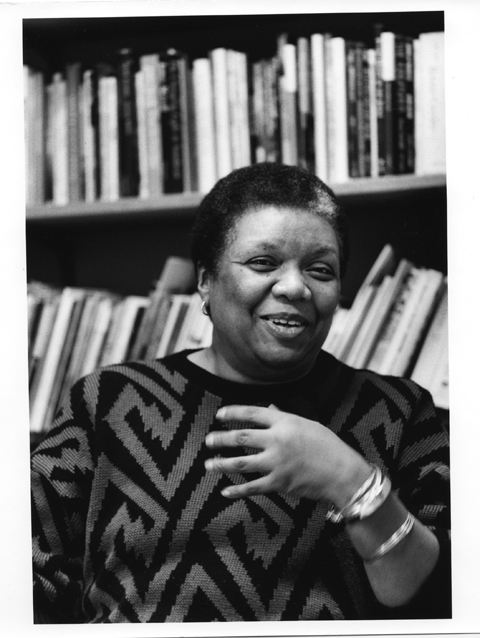
KOKUMỌ: Lucille Clifton. Grandsons!!

CLIFTON_resized

KOKUMỌ

Photographs, my grandsons spinning in their joy.

universe
keep them turning —turning
black blurs against the window
of the world
for they are beautiful
and there is trouble coming
round and round and round

Lucille Clifton
In: the Oxford Anthology of African-American Poetry.
Ed. Arnold Rampersad; Associate Ed. Hilary Herbold.


BUY the book:

USED: http://www.abebooks.com/servlet/SearchResults?sts=t&tn=oxford+anthology+of+african-american+poetry
NEW from a local bookstore: http://www.indiebound.org/book/9780195125634

Mariah L. Richardson: Butter Cream. Lesbian love and sex.

Web_Richardson

Photographer unknown.

Girl on Girl touching. A poem. Most definitely FTW.

Mariah L. Richardson
Butter Cream

She walks
like soft cake
butter sweet
and light

my appetite whet

the day
cold
snow

I was seeking
her spring whirrs
hums like the land
black and wet

inside her sanctuary
I stand stare
nervous windows sweat
to spite the cold
blackened trees
bare branches
etching
the grey, grey sky

I dream of
curling curving
into a cadence
take her in until
we occupy
the same place
the same space

caressing her
I touch myself

I feel delicious

rose chiffon light
echoes off my skin

brushing close
she says through
Cheshire grin
“if I like it,
I lick it.”

bouquet of
myrrh sandalwood
wafts and billows

faux ming vase
bursting of cattails
and pussy willow
tease in the corner

atop
the big, big bed
royal purple
gold sheets
satin raw silk
gregorian chants
whisper lusty devotions
my mouth goes dry
my eyes wide
damp palms grasp
headboard slats
for hands to hold

“breathe”
she says as
she parts me
“breathe”

her breath warms
I am made soft
wanting wanting
dancing on my skin
I stretch/contract
clutch pillow
to the place
she tastes me
I hear the color red
feel golden and sun
piercing through
eyes sliding back
fluttering behind
closed lids

“open your eyes

see,”
she sighs

I ride and ride
surrender deep
into eyes reflecting
rain and fire and all
that is song

I ride and ride
her breath
my breath
my breath
I try to catch
in earth cracks
and breaks
lava spews and
monsoons and cave- ins
and rapture
revelations
jesus
coming
coming

outside a pewter sky
flocked by crows
mirror our black bodies
rising


images

‪#‎BlackVoicesMatter‬
‪#‎BlackPoetsFTW‬

http://www.stlamerican.com/entertainment/living_it/article_a4fd871c-60e0-11e0-86b6-001cc4c03286.html


http://www.uppityco.com/sticksandstones.html


Mariah L. Richardson is a native of St. Louis. She received her BA in Communications from the University of New Mexico and an MFA from Smith College in Playwriting. Mariah began her acting career while in New Mexico. Afterwards, she returned to St. Louis and did two seasons with the St. Louis Black Repertory and three seasons with Metro Theater Company. Her HBO/New Writers Project solo performance show, all that… has toured throughout the country. Her play, Sistahs Indeed! was a main stage production at St. Louis Community College at Forest Park in 2008. In 2007, Metro Theater Company commissioned her to write Delilah’s Wish which won a Kevin Kline Award in 2011 and was published by Dramatic Publishing. Mariah is a budding filmmaker with several films under her belt. Her first short film 5 of Cups, premiered in The Center’s Film Festival in New York in 2004. Her third film, Beautiful Hands made the rounds in film festivals, being screened by Chicks with Flicks in New York City and The St. Louis International Film Festival Fall 2006. Her latest short, Lies We Tell Ourselves, was screened in the 2011 St. Louis Filmmakers Showcase and was in the St. Louis International Film Festival in November 2011. As well as actor and filmmaker, Mariah is also an accomplished poet having her work published in many anthologies and magazines such as Essence, Sinister Wisdom, and Harbinger as well as her own chapbook titled, Stronger Than My Fears.  She is an adjunct professor for St. Louis Community College at Forest Park. She has taught in after school programs, residences and homeless shelters from Los Angeles to New England. Mariah’s goal is to combine all the things she loves; poetry, performance, film, and music together to create work which inspires others to tell their own stories and to radiate the Creator Spirit within.


Established in 1970, Glad Day Bookshop is the world’s oldest LGBTQ bookstore and Toronto’s oldest surviving bookstore. In 2012, a group of 23 community members pooled their funds and bought Glad Day Bookshop to save it from closing.

“Our best strategy for survival is adding new revenues streams like food and drink – which means a larger space.
We’ve picked out a great spot on Church Street that would allow us to be a bookstore & coffee shop during the day and a bar at night.
It is wheelchair accessible, with an accessible washroom.

It has a cute patio, a small space for performances and walls for art.

We will be a space where everyone feels welcome, sexy and celebrated.

We will be a queer-owned, indie place on Church Street. We will amplify the love, creativity, sexuality, diversity & liberation that Glad Day Bookshop is known for.”

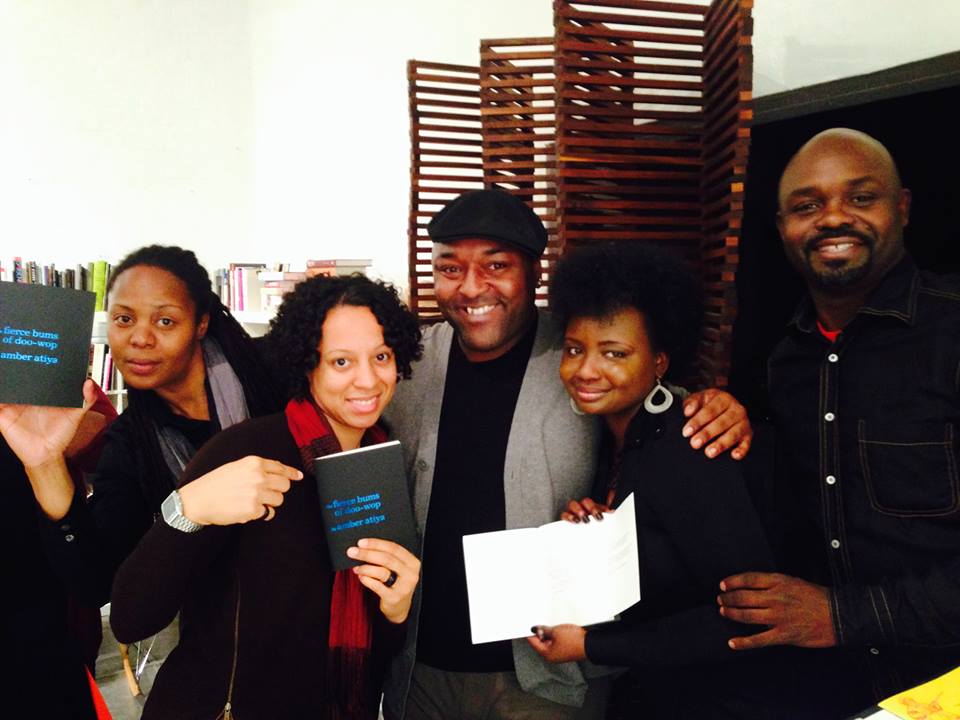
If my slumlord allowed pets- Amber Atiya

tumblr_nedo53sYwC1teummlo1_1280

Second from right. Photo at http://amberatiya.tumblr.com


if my slumlord allowed pets

i’d adopt every
after hour paw
mauled in battle

trimmed with scabs
toppling trash
for fries & wing tips

fur splattered
with egg foo young

these streets
weren’t paved
for tenderness

a tabby’s pregnant belly
low-hanging
as a rain cloud

a swollen nimbus
grazing the ground

by Amber Atiya
.
.
.
‪#‎BlackVoicesMatter‬
‪#‎BlackPoetsFTW‬
‪#‎GeniusBlackAmerica‬

http://www.poetshouse.org/programs-and-events/workshops-classes-residencies/emerging-poets-residency/amber-atiya

Amber Atiya, a queer poet and native Brooklynite, has performed at the Nuyorican Poets Café, Theater for the New City, Westbeth Center for the Arts, and many elsewheres. Her poems have been published in Tribes MagazineDrunken Boat, and Coloring Book, an anthology of multicultural writers. She is a member of a women’s writing group, with whom she’s been writing for ten years and counting.

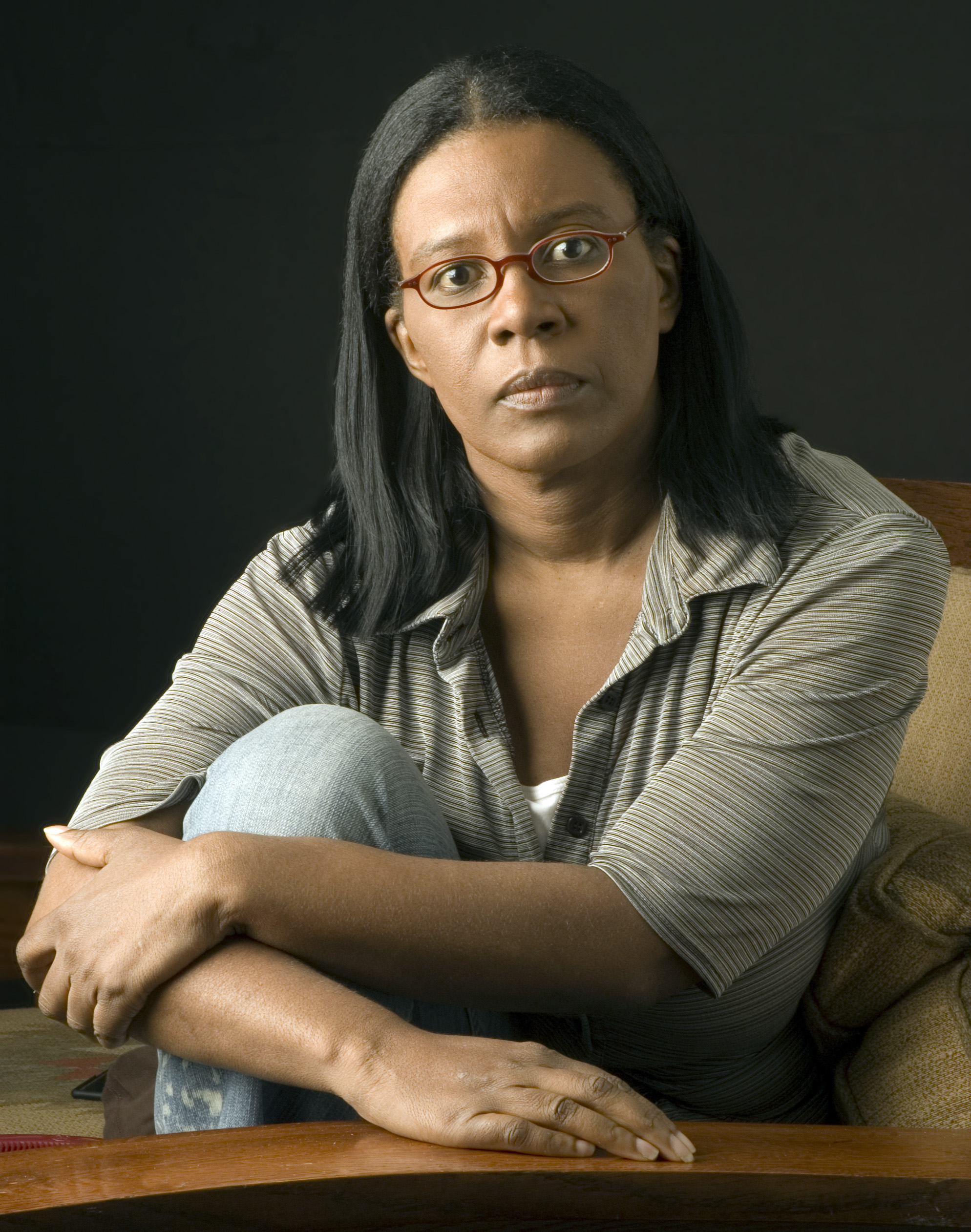
From: Citizen by Claudia Rankine

Rankine-Claudia-hr
Image Credit: CSU Fullerton
 .
 .
 .
CLAUDIA RANKINE co-edited the anthology American Women Poets in the 21st Century: Where Lyric Meets Language, and her work is included in several anthologies, including Great American Prose Poems: From Poe to the Present, Best American Poetry 2001, Giant Step: African American Writing at the Crossroads of the Century, and The Garden Thrives: Twentieth Century African-American Poetry. Her work has been published in numerous journals including Boston Review, TriQuarterly, and The Poetry Project Newsletter. She lives and teaches in California. She is the Holloway/Mixed Blood poet for the spring series.
 .
 .
You are in the dark, in the car, watching the black-tarred street being swallowed by speed; he tells you his dean is making him hire a person of color when there are so many great writers out there.
/
You think maybe this is an experiment and you are being tested or retroactively insulted or you have done something that communicates this is an okay conversation to be having.
Why do you feel okay saying this to me? You wish the light would turn red or a police siren would go off so you could slam on the brakes, slam into the car ahead of you, be propelled forward so quickly both your faces would suddenly be exposed to the wind.
/
As usual you drive straight through the moment with the expected backing off of what was previously said. It is not only that confrontation is headache producing; it is also that you have a destination that doesn’t include acting like this moment isn’t inhabitable, hasn’t happened before, and the before isn’t part of the now as the night darkens 
and the time shortens between where we are and where we are going.
/
When you arrive in your driveway and turn off the car, you remain behind the wheel another ten minutes. You fear the night is being locked in and coded on a cellular level and want time to function as a power wash. Sitting there staring at the closed garage door you are reminded that a friend once told you there exists a medical term — John Henryism — for people exposed to stresses stemming from racism. They achieve themselves to death trying to dodge the build up of erasure. Sherman James, the researcher who came up with the term, claimed the physiological costs were high. You hope by sitting in 
silence you are bucking the trend.
/
When the stranger asks, Why do you care? you just stand there staring at him. He has just referred to the boisterous teenagers in Starbucks as niggers. Hey, I am standing right here, you responded, not necessarily expecting him to turn to you.
He is holding the lidded paper cup in one hand and a small paper bag in the other. They are just being kids. Come on, no need to get all KKK on them, you say.
Now there you go, he responds.
The people around you have turned away from their screens. The teenagers are on pause. There I go? you ask, feeling irritation begin to rain down. Yes, and something about hearing yourself repeating this stranger’s accusation in a voice usually reserved for your partner makes you smile.
/
A man knocked over her son in the subway. You feel your own body wince. He’s okay, but the son of a bitch kept walking. She says she grabbed the stranger’s arm and told him to apologize: I told him to look at the boy and apologize. And yes, you want it to stop, you want the black child pushed to the ground to be seen, to be helped to his feet and be brushed off, not brushed off  by the person that did not see him, has never seen him, has perhaps never seen anyone who is not a reflection of himself.
The beautiful thing is that a group of men began to stand behind me like a fleet of  bodyguards, she says, like newly found uncles and brothers.
/
The new therapist specializes in trauma counseling. You have only ever spoken on the phone. Her house has a side gate that leads to a back entrance she uses for patients. You walk down a path bordered on both sides with deer grass and rosemary to the gate, which turns out to be locked.
At the front door the bell is a small round disc that you press firmly. When the door finally opens, the woman standing there yells, at the top of her lungs, Get away from my house. What are you doing in my yard?
It’s as if a wounded Doberman pinscher or a German shepherd has gained the power of speech. And though you back up a few steps, you manage to tell her you have an appointment. You have an appointment? she spits back. Then she pauses. Everything pauses. Oh, she says, followed by, oh, yes, that’s right. I am sorry.
I am so sorry, so, so sorry.
/
.
 .
 .

BUY!
USED: http://www.abebooks.com/servlet/SearchResults?sts=t&tn=American+Women+Poets+in+the+21st+Century%3A+Where+Lyric+Meets+Language&x=0&y=0
NEW from Independent bookstores: http://www.indiebound.org/book/9780819565471

RIP MC Big Bank Hank- rapper Legend! Sugar Hill Gang.

Rest in Peace, Rappers’ Legend, MC Big Bank Hank, of the legendary Sugar Hill Gang. Aged 58.

I remember “Rapper’s Delight”! (not the misogyny or the homophobia that is in there).

“I said a hip hop,
Hippie to the hippie,
The hip, hip a hop, and you don’t stop, a rock it
To the bang bang boogie, say, up jump the boogie,
To the rhythm of the boogie, the beat.
Now, what you hear is not a test – I’m rappin’ to the beat,
And me, the groove, and my friends are gonna try to move your feet.
See, I am Wonder Mike, and I’d like to say hello,
To the black, to the white, the red and the brown,
The purple and yellow…”