Act Six, After Babel by Peter Goldsworthy. Poems about theatre and sex- Australia.

Act Six

Act six begins
when the curtain falls,
the corpses awake,
the daggers are cleaned.

Act six
is Juliet in the supermarket,
Mr Macbeth on the 8.15.

In act six
Hamlet sucks a tranquilliser,
Romeo washes up.

and death
is gentle and anonymous —
Lear’s respirator
switched discreetly off.

After Babel

I read once of a valley
where men and women
spoke a different tongue.

I know that any uncooked theory
can find its tribe
— but this one might be true.

For us there are three languages
— yours, mine, and the English between,
a wall of noises.

At times our children interpret,
or music connects our moods.
There are monosyllables,

the deeper grammar of fucking,
a language too subjective
for nouns.

But even after conjugation
the tense is still the same
— present imperfect.

We take our mouths from each other.
We carry away our tongues,
and the separate dictionaries of our heads.

.


The New Oxford Book of Australian Verse, chosen by Les A. Murray
USED: http://www.abebooks.com/servlet/BookDetailsPL?bi=14144434264

Winter fun, hardship and a gentleman without a home- by T.E. Hulme

The Embankment

Once, in finesse of fiddles found I ecstasy,
In the flash of gold heels on the hard pavement.
Now see I
That warmth’s the very stuff of poesy.
Oh, God, make small
The old star-eaten blanket of the sky,
That I may fold it round me and in comfort lie.

.

 T.E. Hulme

.

Yiddish poetry by Mani Leib and Abraham Reisen!

“Indian Summer,” by Mani Leib

My Indian Summer, like an offering,
Burns into gold and spirals of smoke.
With brown hand, I push my last
Starry ember through the ash.
Night and villages. On moonlit flutes
The crickets play a breaking music on my heart;
In white grass, by blue-washed pickets,
Gourds are yellow like the moon.
Trees —blue, waxen— in cool space shining.
Like candles, upright: men fearful before God.
Sharp in stillness, the fall of a spent leaf.
Even sharper —the worries in my step.
.
.
And by Abraham Reisen “A Song”

The sweetest melody,
Your heart can sing
Keep for your autumn hour,
Not for the spring.

Glad is the blossom time
With its own tune and chime;
Ah, but the sunset day—
Sing it away.
.
.

From: a Treasury of Yiddish Poetry edited by Irving Howe and Liezer Greenberg.
USED and NEW: http://www.abebooks.com/servlet/BookDetailsPL?bi=13535919967 

Winter Solstice poems: Old Irish/Mother Goose!

I have news for you

(9th century Irish)

I have news for you:
The stag bells, winter snows, summer has gone
Wind high and cold, the sun low, short its course
The sea running high.
Deep red the bracken; its shape is lost;
The wild goose has raised its accustomed cry,
cold has seized the birds’ wings;
season of ice, this is my news

In the Green Wood from Mother Goose
(making the fire)

Oak-logs will warm you well,
That are old and dry;
Logs of pine will sweetly smell
But the sparks will fly.
Birch-logs will burn too fast,
Chestnut scarce at all;
Hawthorn-logs are good to last –
Catch them in the fall.
Holly-logs will burn like wax,
You may burn them green;
Elm-logs like to smoldering flax,
No flame to be seen.
Beech-logs for winter time,
Yew-logs as well;
Green elder-logs it is a crime
For any man to sell.
Pear-logs and apple-logs,
They will scent your room,
Cherry-logs across the dogs
Smell like flower of the broom.
Ash-logs, smooth and grey,
Burn them green or old,
Buy up all that come your way –
Worth their weight in gold.

Child in the gardens. Vincent O’Sullivan

The Child in the Gardens

How sudden, this entering the fallen
gardens for the first time, to feel the blisters
of the world’s father, as his own hand
does. It is everything dying at once,
the slimed pond and the riffling of leaves,
shoes drenched across sapless stalks.
It is what you will read a thousand times.
You will come to think, who has not stood
there, holding that large hand, not said
Can’t we go back? I don’t like this place.
Your voice sounds like someone else’s. You
rub a sleeve against your cheek, you want
him to laugh, to say, ‘The early stars can’t hurt
us, they are further than trains we hear
on the clearest of nights.’ We are in a story
called Father, We Must Get Out.
Leaves scritch at the red walls,
a stone lady lies near the pond, eating
dirty grass. It is too sudden, this
walking into time for its first lesson,
its brown wind, its scummed nasty
paths. You know how lovely yellow
is your favourite colour, the kitchen at home.
You touch the big gates as you leave,
the trees stand on their bones, the shoulders
on the vandaled statue are huge cold
eggs. Nothing there wants to move.
You touch the gates and tell them, We
are not coming back to this place. Are we, Dad?

Vincent O’Sullivan

From: Nice Morning for It, Adam (Victoria University Press, 2004)
USED and NEWhttp://www.abebooks.com/servlet/BookDetailsPL?bi=881208234

Independent NZ bookstores: http://booksellers.co.nz/members/resources%20for%20booksellers/booksellers%20gift%20cards

More information about the poet:
http://www.poetryarchive.org/poet/vincent-osullivan

Rosa Gutman Jasny: The Faraway Moon. Yiddish poetry!

Because sometimes you can’t get a woman out of your mind. Not even by watching Buffy. Or The Good Wife. This poem especially the last line, shows so much tenderness and knowing…

Rosa Gutman Jasny “produced much of their work in Eastern Europe […] also found their way to New York at various stages in their lives. The lives of several women writers were spent in a perpetual state of wandering…”
http://jwa.org/encyclopedia/article/yiddish-womens-poetry

The Faraway Moon

The faraway moon, has she already heard
That any minute now
She’s to become a world by herself?
No longer lotus flower, tender and bemused —
Just an ordinary drab world.

Today she shows us half her face,
drawn and pale.
That blond capricious moon —
What might she not do from rage?

Turn swiftly to her lords on high,
And scatter all dreams since time began,
Like dust into outer space?

Oh no, moon, don’t.

.

Poem by Rosa Gutman Jasny and translated from Yiddish to English by Etta Blum.

Treasury of Yiddish Poetry. Edited by Irving Howe, Eliezer Greenberg.

USED and NEW: http://www.abebooks.com/servlet/BookDetailsPL?bi=13535919967

“Been a train crash… An black man didn drive? No. Black man didn drive”.

James Berry (OBE, 1924-) From Jamaica to the UK!

Two Black Labourers on a London Building Site

Been a train crash.
.   Wha?
Yeh — tube crash.
.   Who the driver?
Not a black man.
.   Not a black man?
I check that firs.
.   Thank Almighty God.
Bout thirty people dead.
.   Thirty people dead?
Looks maybe more.
.   Maybe more?
Maybe more.
.   An black man didn drive?
No. Black man didn drive.
.

.

A Story I am in: Selected Poems by James Berry:
NEW and USED: http://www.abebooks.co.uk/servlet/BookDetailsPL?bi=12538913206

From: London a History in Verse, ed by Mark Ford.
NEW: http://www.localbookshops.co.uk
USED: http://www.abebooks.com/servlet/BookDetailsPL?bi=9186279941

From Wiki with thanks:

Selected publications

  • Bluefoot Traveller: An Anthology of Westindian Poets in Britain (editor), London: Limestone Publications, 1976; revised edition Bluefoot Traveller: Poetry by West Indians in Britain, London: Harrap, 1981
  • Fractured Circles (poetry), London: New Beacon Books, 1979
  • Lucy’s Letters and Loving, London: New Beacon Books, (1982)
  • News for Babylon: The Chatto Book of Westindian-British Poetry (editor), London: Chatto & Windus, 1984
  • Chain of DaysOxford University Press, 1985
  • A Thief in the Village and other stories (for children), London: Hamish Hamilton, 1987
  • The Girls and Yanga Marshall: four stories (for children), London: Longman, 1987
  • Anancy-Spiderman: 20 Caribbean Folk Tales (for children), illustrated by Joseph Olubo, London: Walker, 1988
  • When I Dance (for children), Hamish Hamilton, 1988
  • Isn’t My Name Magical? (for children), Longman/BBC, 1990
  • The Future-Telling Lady and other stories (for children), London: Hamish Hamilton, 1991
  • Ajeemah and his Son (for children), USA: HarperCollins, 1992
  • Celebration Song (for children), London: Hamish Hamilton, 1994
  • Classic Poems to Read Aloud (editor), London: Kingfisher, 1995
  • Hot Earth Cold EarthBloodaxe Books, 1995
  • Playing a Dazzler (for children), London: Hamish Hamilton, 1996
  • Don’t Leave an Elephant to Go and Chase a Bird (for children), USA: Simon & Schuster, 1996
  • Everywhere Faces Everywhere (for children), Simon and Schuster, 1997
  • First Palm Trees (for children), illustrated by Greg Couch, Simon & Schuster, 1997
  • Around the World in 80 Poems (editor – for children), London: Macmillan, 2001
  • A Nest full of Stars (for children), London: Macmillan, 2002
  • Only One of Me (selected poems – for children), London: Macmillan, 2004
  • James Berry Reading from his poems for children, CD, The Poetry Archive, 2005
  • Windrush SongsBloodaxe Books, 2007
  • A Story I Am In: Selected Poems, Bloodaxe Books, 2011

Awards

Winter Solstice, “Three Trees at Solstice”, Mary Finn

Three Trees at Solstice

Comes with autumn the spent moment,
When, polarized to stillness,
The soul thereafter waits on death
As oaks on winter
As oaks by winter water.
So stands the sun for springing and failing time;
And a life ending is less than a stream failing
Until, sunk deep in a white meander —
Black clouds come down like swans at brood,
And flows again the white water.

The silver tree of the stream
Fails not for the sea,
Nor for the thirst-hewn rocks of the valley;
But fails the red, bright tree
In each man’s breast—
Drooping to winter’s rest;
Fails the yellow tree
Of each day’s light—
Fails from sight,
Fails in the west.

Mary Finnin

A Book of Australian Verse edited by Judith Wright

Elvira Hernández: The Flag of Chile/ La Bandera de Chile

The Flag of Chili 1st page

The Flag of Chili 1st page

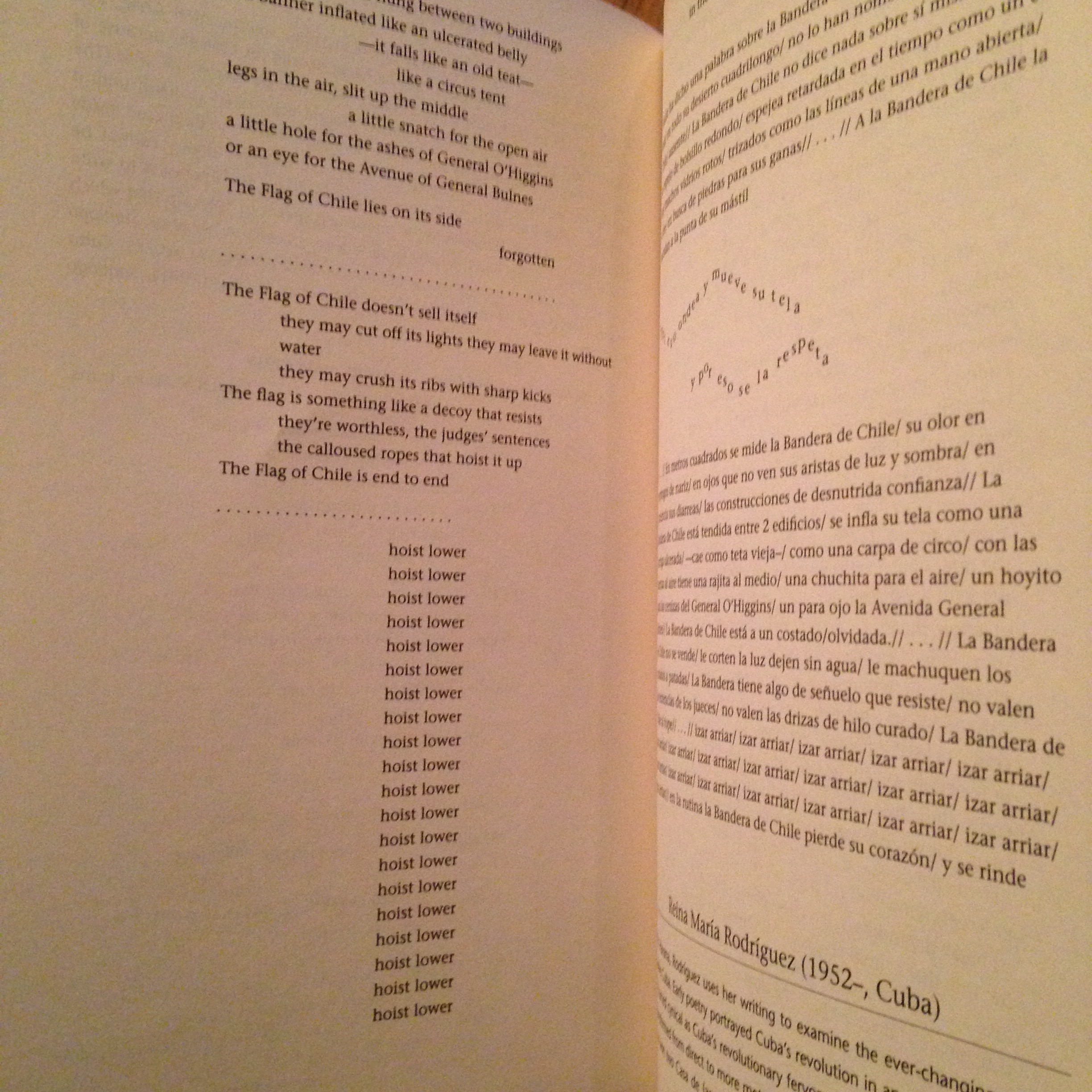
Excerpt from: The Flag of Chile

.              No one has said a word about the flag of Chile
.                              about its nobility its cloth
.                           about its rectangular desert
.                               They haven’t proclaimed
.                                     the Flag of Chile
.                                            missing

.                  The flag of Chile says nothing about itself
.                    it reads itself in a round pocket mirror
.                    it gleams delayed in time like an echo
.                           there’s a lot of broken glass
.                   smashed like the lines in an open hand
.                                        it reads itself
.                             seeking stones for its desire

.                          …………………………………………..

.                  They order the Flag of Chile to its mast-tip
.                      and                   this its fa                  tes and mo
.                             because of               bric undula                  ves


.                                                              cause of                   spect
.                                                   and be               this they re           it

.                          ……………………………………………

.                  The Flag of Chile is measured in square meters
.                             its smell measured by twitches of the nose
.                    it’s measured by eyes so blind to its facets of light and shadow
.                              by patience for its diarrheas
.                    the construction of malnourished trust

.               The Flag of Chile is hung between two buildings
.                its banner inflated like an ulcerated belly
.                                        — it falls like an old teat —
.                                                like a circus tent
.                Legs in the air, slit up the middle
.                                         a little snatch for the open air
.                  a little hole for the ashes of General O’Higgins
.                  or an eye for the Avenue of General Bulnes

.                  The Flag of Chile lies on its side
.                                                                            forgotten

.                    ……………………………………………………………..

.                   The Flag of Chile doesn’t sell itself
.                              they may cut off its lights they may leave without
.                              water
.                              they may crush its ribs with sharp kicks
.                   The flag is something like a decoy that resists
.                              they’re worthless, the judges’ sentences
.                              the calloused ropes that hoist it up
.                    The Flag of Chile is end to end

.                    ………………………………………..
.                                                      hoist lower

.                                    in the routine the Flag of Chile loses heart
.                                                                                            and surrenders


Poetry book for people who just started reading poetry today and those who have read miles of it. Very good buy.

The Oxford Book of Latin American poetry, a bilingual anthology, ed. Cecilia Vicuña and Ernesto Livon-Grosman.

USED: http://www.abebooks.com/servlet/SearchResults?sts=t&tn=The+Oxford+Book+of+Latin+American+poetry
NEW at independent bookstore:  http://www.indiebound.org/book/9780195124545

spanish

spanish

If you read the language, this is interesting: http://letras.s5.com/eh290910.html

The Flag of CHili 2nd page

Isabel Fraire, Mexico: The Housing Complex, Complejo habitational!

A moment Captured by a Japanese Painter of the Eighteenth Century Seen in a Moment of the Twentieth Century in a London Gallery.

a plump black
bird
not very attractive
head feathers bristling
from cold
or wind
forcefully clings to
a nearly vertical branch

his posture tells us
that the branch
is being stirred by the wind

the bird
stares
with small black eyes
like seeds
or buttons
at something
outside the scene
we cannot see

Untitled

the minute the sun comes out
.      everything is beside the point
.                 it is enough
.                               to open your eyes
.                             to stretch your limbs
.                                     like a cat

[…]

Housing complex

I
morning rises slowly like a mist climbing
.                 and spreading through the air

a child crosses             squares of green grass
.           running            jumping          running
.                  carrying
.                          a shopping bag in its hand

II
the apartment buildings
.                           present flat rectangular            surfaces

.           the windows are equipped with fray steel shutters
.           that close   or open
.                               like lids
.                                                    each room a box

the garden           of smooth green grass              like a new carpet
.           is framed by regular rows of identical trees
.                        that cast an oblong shadow
.                                     like a wall

III
no one speaks to each other here                  a neighbour tells me
.           breaking the rule
.                                  after a year
at predetermined hours
.                                    two or threw old men and a child
.                                        take their respective dogs out for a walk
.                          one of them is in the habit of
.                                                        letting the dog run loose
.                          the others stop
.                                each time
.                                                        the dog stops

IV
usually silence prevails
.                                 broken only by the noise of traffic
.                   that swells
.                                 at the hours when offices open or close

but occasionally
.     through paper-thin walls     one overhears
.               a bitter violent               discussion
.                                                full of resentment
.                                or a ruined life
.             melodramatic panting
.                                          background music
.                               from the television set
V
a block away
.            large bulldozers
.            busily demolish a small grove
in order to erect a mass of buildings
.            exactly like this one

.


If you want an easy, fun, interesting, cool book of poetry and you don’t normally read much, this is your book. Together with the Anthology of African American Verse. It’s like reading short Facebook updates.

Thomas Hoeksema translator

The Oxford Book of Latin American poetry, a bilingual anthology, ed. Cecilia Vicuña and Ernesto Livon-Grosman.

USED: http://www.abebooks.com/servlet/SearchResults?sts=t&tn=The+Oxford+Book+of+Latin+American+poetry
NEW at independent bookstore: http://www.indiebound.org/book/9780195124545

Australian (Aboriginal) Poetry 2: Judith Rodriguez, Nigel Roberts!

After / the Moratorium Reading

.         the marie antoinette / slice
.                   of cake / was
.       awarded to
.                              who ever said
.            after this reading / let’s
. get it on / at Michael’s place / I heard
.                                       that guy
.       from Canberra’s got
.                   some farout
.                   vietnamese
.                        shit.

Nigel Roberts (re: Michael Wilding)

Eskimo Occasion

I am in my Eskimo-hunting-song mood,
Aha!
The lawn is tundra    the car will not start
The sunlight is an avalanche     we are avalanche-struck at our
.    breakfast
struck with sunlight through grass    me and my spoonfed daughters
out of this world in our kitchen

I will sing the song of my daughter-hunting,
Oho!
The waves lay down     the ice grew strong
I sang the song      of dark water under ice
the song of the winter fishing     the magic for seal rising
among the ancestor-masks.

I waited by water to dream new spirits,
Hoo!
The water spoke     the ice shouted
the sea opened      the sun made young shadows
they breathed my breathing       I took them from deep water
I brought them fur-warmed home.

I am dancing the year of the two great hunts,
Ya-hay!
It was I who waited       cold in the wind-break
I stamp like the bear       I call like the wind of the thaw
I leap like the sea spring-running.         My sunstruck daughters
.      splutter
and chuckle and bang their spoons:

Mummy is singing at breakfast and dancing!
So big!

Judith Rodriguez

From: The New Oxford Book of Australian Poetry

Australian (Aboriginal) poetry- Sam Mitchell (m), J.S. Harry (f), Kate Llewellyn!

Thunderstorm

After sundown the clouds start to burn,
A big one is bending low, stays and breaks up,
Then it rounds again and raises its forehead high.
On both ends sheet lightning shines.
In the middle where the first layer is gone,
You can see the flash, even inside your home.
Everything dissolves.
In the desert, wide-spread falls the cloudburst,
Drenching all the trees between the two sandhills.

Song by Sam Mitchell, sung in Njangumarda language and translated by S. Mitchell and Georg Brandenstein.

Honesty-Stones

The land between us
had grown so bare
the landscape so denuded—
all we had left was what we knew—
just the rocks and the shades they cast—
your eyes my eyes, across them.

We did not need to speak, to talk.
Everything was in the rocks.
It had been said before.

We could not live there.

J.S. Harry

Colonel

He rode a white horse
heading the Anzac Day Parade
fought at Ladysmith
and Gallipoli
was 90
tall
and treated me
as his batman

helping him
down the hospital corridor
seemed holding rare archeology
by the elbow

I apologized for clumsiness
he said ‘Never mind Sister
every beginning is difficult’
but he said it in Latin

his marriage of 60 years ended
when she died
he ran the funeral elegantly
with military style
and died a month later

Kate Llewellyn

The New Oxford Book of Australian Verse, chosen by Les A. Murray.

USED: http://www.abebooks.com/servlet/BookDetailsPL?bi=14144434264

NOURISHING TERRAINS, Australian Aboriginal Views of Landscape and Wilderness:
http://www.environment.gov.au/system/files/resources/62db1069-b7ec-4d63-b9a9-991f4b931a60/files/nourishing-terrains.pdf

Najam Hosain Syed: Night a Burning Oven. Muslim poetry about desire and the body!

Night a Burning Oven

Throw your hand in and place the dough
Many were cooked over flat pans
Eyes were singed lighting damp wood
Now wear the coal of this heat in your eyes
Raise your arms and dance in it
Red wheat has sprouted during the course of time Night a burning oven
Throw your hand in and place the dough
Lay your virtues on the table
Serve yourself and feed yourself
Who knows when the day will rise, how it will rise
Whoever beheld the daybreak
Will not return to tell

Translated by Zubair Ahmad and Fauzia Rafiq

Click to access 13.1.2_Ahmad.pdf

USED: http://www.abebooks.com/servlet/BookDetailsPL?bi=8962523344

http://www.mptmagazine.com/author/najm-hosain-syed-5469/
“Najm Hosain Syed is the most significant Punjabi writer of post-Partition West Punjabi literature. He was born in 1936 in Batala eastern Punjab. After Partition in 1947, his family had to move to Lahore in Pakistan. He did his masters in English literature from Punjab University and joined Pakistan civil service and retired as Accountant General of Punjab.

He founded the Punjabi Sangat -literary study group- and the Majlis Shah Hussain -a publishing venture- in the early 1970s. During the time he also headed the post-graduate Department of Punjabi in Punjab University. He has authored more than 30 books of poetry, plays and creative non-fiction. “

Creation: God and the animals look after the people. Indigenous poem and story!

http://www.rattle.com/poetry/print/10s/i14/ OUT of print, indigenous poets.

Native Creation Story. By Phil Lane as told by Richard Wagamese. I love these lines of encouragement and responsibility- a legal contract of sorts between God and the Animal People.

“You will need to be more than brothers and sisters, you will need to be his teachers.”

And the Creator thinks all their ideas are good and still wants to find another place. The smallest of the Animal People and not very powerful, the mole, has the best idea– this is a legal tradition whereby not only judges and politicians create the laws, but the least powerful are acknowledged, welcomed and show they have good ideas.

.

God and the Animal People look after a new creature.

IN THE TIME BEFORE there were human beings on Earth, the Creator called a great meeting of the Animal People.

During that period of the world’s history, the Animal People lived harmoniously with one another and could speak to the Creator with one mind. They were very curious about the reason for the gathering. When they had all assembled together, the Creator spoke.

“I am sending a strange new creature to live among you,” he told the Animal People. “He is to be called Man and he is to be your brother.

“But unlike you he will have no fur on his body, will walk on two legs and will not be able to speak with you. Because of this he will need your help in order to survive and become who I am creating him to be. You will need to be more than brothers and sisters, you will need to be his teachers.

“Man will not be like you. He will not come into the world like you. He will not be born knowing and understanding who and what he is. He will have to search for that. And it is in the search that he will find himself.

“He will also have a tremendous gift that you do not have. He will have the ability to dream. With this ability he will be able to invent great things and because of this he will move further and further away from you and will need your help even more when this happens.

“But to help him I am going to send him out into the world with one very special gift. I am going to give him the gift of the knowledge of Truth and Justice. But like his identity it must be a search, because if he finds this knowledge too easily he will take it for granted. So I am going to hide it and I need your help to find a good hiding-place. That is why I have called you here.”

A great murmur ran through the crowd of Animal People. They were excited at the prospect of welcoming a new creature into the world and they were honoured by the Creator’s request for their help. This was truly an important day.

One by one the Animal People came forward with suggestions of where the Creator should hide the gift of knowledge of Truth and Justice.

“Give it to me, my Creator,” said the Buffalo, “and I will carry it on my hump to the very centre of the plains and bury it there.”

“A good idea, my brother,” the Creator said, “but it is destined that Man should cover most of the world and he would find it there too easily and take it for granted.”

“Then give it to me,” said the Salmon, “and I will carry it in my mouth to the deepest part of the ocean and I will hide it there.”

“Another excellent idea,” said the Creator, “but it is destined that with his power to dream, Man will invent a device that will carry him there and he would find it too easily and take it for granted.”

“Then I will take it,” said the Eagle, “and carry it in my talons and fly to the very face of the Moon and hide it there.”

“No, my brother,” said the Creator, “even there he would find it too easily because Man will one day travel there as well.”

Animal after animal came forward with marvellous suggestions on where to hide this precious gift, and one by one the Creator turned down their ideas. Finally, just when discouragement was about to invade their circle, a tiny voice spoke from the back of the gathering. The Animal People were all surprised to find that the voice belonged to the Mole.

The Mole was a small creature who spent his life tunnelling through the earth and because of this had lost most of the use of his eyes. Yet because he was always in touch with Mother Earth, the Mole had developed true spiritual insight.

The Animal People listened respectfully when Mole began to speak.

“I know where to hide it, my Creator,” he said. “I know where to hide the gift of the knowledge of Truth and Justice.”

“Where then, my brother?” asked the Creator. “Where should I hide this gift?”

“Put it inside them,” said the Mole. “Put it inside them because then only the wisest and purest of heart will have the courage to look there.”

And that is where the Creator placed the gift of the knowledge of Truth and Justice.
.
.
Found in “Indigenous Legal Traditions,” Prof. John Borrows.

“Professor and Chair in Aboriginal Justice and Governance, Faculty of Law, University of Victoria. The author would like to acknowledge the support of the Law Commission of Canada and the Social Sciences and Humanities Research Council in the preparation of this Article.”
Footnote 152:
Based on a story by Phil Lane, Jr., Four Worlds Development, University of Lethbridge, Lethbridge, Alberta, as retold by Richard Wagamese, in ROYAL COMMISSION ON ABORIGINAL PEOPLES, RESTRUCTURING THE RELATIONSHIP (1996)

DONATE:
https://idlenomore.nationbuilder.com/donate
ACTION:
http://www.idlenomore.ca/events
Resources:
http://www.idlenomore.ca/resources