Unknown's avatar

About Frédéric.Arps.blogs

https://twitter.com/FreddieArps

The Bagel & Rescue The Dead, Ignatow #poem

The Bagel

I stopped to pick up the bagel
rolling away in the wind,
annoyed with myself
for having dropped it
as if it were a portent.
Faster and faster it rolled,
with me running after it
bent low, gritting my teeth,
and I found myself doubled over
and rolling down the street
head over heels, one complete somersault
after another like a bagel
and strangely happy with myself.


And this weird, ridiculous, desperate and lovely poem…He sounds so depressed. Obviously  everything that he describes as not being love, can be love. Love of the small things in your day. A commitment not to draw attention to drama- which is fine, if you work through the drama at some point. Anyway. It is interesting to see his muted style.

Rescue the Dead

Finally, to forgo love is to kiss a leaf,
is to let rain fall nakedly upon your head,
is to respect fire,
is to study man’s eyes and his gestures
as he talks,
is to set bread upon the table
and a knife discreetly by,
is to pass through crowds
like a crowd of oneself.
Not to love is to live.

To love is to be led away
into a forest where the secret grave
is dug, singing, praising darkness
under the trees.

To live is to sign your name,
is to ignore the dead,
is to carry a wallet
and shake hands.

To love is to be a fish.
My boat wallows in the sea.
You who are free,
rescue the dead.

—David Ignatow

From: Contemporary American Poetry edited by Donald Hall

Buy from Indie bookstores at abebooks.com here

Established in 1970, Glad Day Bookshop is the world’s oldest LGBTQ bookstore and Toronto’s oldest surviving bookstore. In 2012, a group of 23 community members pooled their funds and bought Glad Day Bookshop to save it from closing.

“Our best strategy for survival is adding new revenues streams like food and drink – which means a larger space.
We’ve picked out a great spot on Church Street that would allow us to be a bookstore & coffee shop during the day and a bar at night.
It is wheelchair accessible, with an accessible washroom.

It has a cute patio, a small space for performances and walls for art.

We will be a space where everyone feels welcome, sexy and celebrated.

We will be a queer-owned, indie place on Church Street. We will amplify the love, creativity, sexuality, diversity & liberation that Glad Day Bookshop is known for.”

Black Poet, White Critic #BlackLivesMatter #poem Dudley Randall

Black Poet, White Critic

A critic advises
not to write on controversial subjects
like freedom or murder,
but to treat universal themes
and timeless symbols
like the white unicorn.

A white unicorn?

.

Dudley Randall

George

When I was a child desiring the title of grown-up
And toiling to earn it
In the inferno of the foundry knockout
I watched and admired you working by my side’
As, goggled, with mask on your mouth and shoulders bright
. with sweat,
You mastered the monstrous, lumpish cylinder blocks,
And when they clotted the line and plunged to the floor
With force enough to tear your foot in two,
You calmly stepped aside.

One day when the line broke down and the blocks clogged up
Groaning, grinding, and mounted like an ocean wave
And then rushed thundering down like an avalanche,
And we frantically dodged, then placed our heads together
To form an arch to lift and stack them,
You gave me your highest accolade:
You said, ‘You’re not afraid of sweat. You’re strong as a mule.’

Now, here, in the hospital,
In a ward where old men wait to die,
You sit, and watch time go by.
You cannot read the books I bring, not even
Those that are only picture books,
As you sit among the senile wrecks,
The psychopaths, the incontinent.

One day when you fell from your chair and stared at the air
With the look of fright which sight of death inspires,
I lifted you like a cylinder block, and said,
‘Don’t be afraid
Of a little fall, for you’ll be here
A long time yet, because you’re strong as a mule.’

From: Contemporary American Poetry edited by Donald Hall

Buy from Indie bookstores at abebooks.com here

The sea is for us all, O mar é para todos nós, Isabel Aguiar, One never returns to the same place.

The sea is for us all

The sea is for us all
The sea has mystical fish
The sea is the Firmament
Only the mystical fish can jump into the nets
The nets Are the Entire Firmament Sparkling.

O mar é para todos nós

O mar é para todos nós
O mar tem peixes místicos
O mar é o Firmamento
Só os peixes místicos sabem saltar para as redes
Só os peixe místicos sabem saltar para as redes
Só os peixes místicos sabem saltar para as redes
As redes São Todo o Firmamento a Luzir.


ONE NEVER RETURNS TO THE SAME PLACE

therefore, when the child left the marigold field behind
he looked back several times

NUNCA SE REGRESSA AO MESMO LUGAR
por isso, quando a criança partiu do campo dos malmequeres
olhou muitas vezes para trás

in Nunca se Regressa ao Mesmo Lugar, 2003


the child counted twenty three lambs

the child counted twenty three lambs, covered in soft wool, in order
to be less cold as she remembered her mother knitting
baby-pink booties.

a criança contou vinte e três carneirinhos

a criança contou vinte e três carneirinhos, cobertos de lã macia, para
sentir menos frio a lembrar-se da mãe a tricotar umas botas de dormir
cor de rosa bebé.
in Nunca se Regressa ao Mesmo Lugar, 2003

© Translated by Ana Hudson, 2012

Sometimes by Helga Moreira

Sometimes when you read a translation, you know it is not right, because it doesn’t make sense and it doesn’t seem to be in the tradition of non-sensical poems.  I remember a little Latin and some Papiamentu:) This is what I think the poem says. If you are fluent in Portuguese and you think I am wrong, I would be glad if you let me know!

Sometimes

I.
Sometimes it’s almost a state.
Almost a tree, almost a lake.

2.
Somewhere in the right place.
Something in the wrong place.
Neither a tree nor a lake.
A complete negation.

3.
Let everything go on and on.
And then you guess right – London Bridge.
Bridges built over a state of panic.
Late evening on a clear night.
Shall we find the horizon
by looking at where it is absent?

1.
Por vezes é quase um estado.
Quase uma árvore, quase um lago.

2.
Um lugar no sítio certo.
Qualquer coisa no sítio errado.
Nem árvore, nem lago.
A negação por completo.

3.
Deixa que tudo siga.
Adivinha-se então – London Bridge.
Pontes por sobre o pânico.
Serão em noite clara.
Vamos adivinhar o horizonte
em negação interrogada?

© Translated by Ana Hudson, 2011. I changed Hudson’s translation.
in Agora que falamos de morrer, 2006

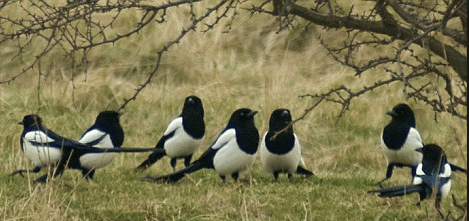
Magpies by Judith Wright

Screen Shot 2016-09-02 at 11.30.54 AMScreen Shot 2016-09-02 at 11.31.35 AM

Photos by Patrick Ingremeau and The Wildlife Studio

Along the road the magpies walk

with hands in pockets, left and right.
They tilt their heads, and stroll and talk.
In their well-fitted black and white

they look like certain gentlemen who seem most nonchalant and wise
until their meal is served – and then
what clashing beaks, what greedy eyes!

But not one man that I have heard
throws back his head in such a song
of grace and praise – no man nor bird.
Their greed is brief; their joy is long.
For each is born with such a throat
as thanks his God with every note.

Judith Wright’s poem Magpies

Day trip by Carole Satymurti

Screen Shot 2016-09-02 at 11.19.08 AM

Daytrip

Two women 70s hold hands
On the edge of Essex
Hair and strong nets
Shrieked Loughter echoing girls as single sucks from under feet
Easing in brine

There must be an unspoken point when the sea feels like
their future. no longer paddling, ankle submerge in lace
in satin ripple.
dress hems darken

they do not risk their balance
for the shimmering of ships
at the horizon’s sweep
as thigh deep they inch on
finger splayed wrists bent learning to walk again

Beatriz Hierro Lopes-It’s almost dark #sexwork is decent

Screen Shot 2016-09-02 at 10.45.57 AM

B/W 1951 Caucasian boy + Black girl walking on rural train tracks / Louisiana / documentary shot credit: Archival Films? No known artist.

It’s almost dark.
Women of different ages await the arrival of someone […] While waiting, they talk to the stones with eyes that bear the widowhood of days. I’ve seen them all my life. Away from the stones, close to the sea. In the days when striped beach huts were hired, picnic lunches and folding chairs were taken to the sand and the children were learning to swim in the sea, well away, golden little dots appearing in the tides. I can see their whole lives. They used to arrive in the morning and leave when the afternoon came to an end, shaking the sand off their feet. Their faces broken by the sun reach out today to the stones’ muteness. I see them and I walk on: this street is a route far too far away from the sea.
It’s dark. The traffic lights illuminate the clearings. The city is a forest where each man is a model for the meagreness of the vineyards. Slow, they walk along the avenue, vine bodies burnt by the January moonlight. The wind triggers no movement at all, not a single gesture: only twigs lie along the dark overcoat of these cold days. These are no women to be talking to stones. […]  I see them coming up the avenue, their shadows going down it, piercing them like a section of a past to which returning is not denied. Each one separate, divided, two marching selves, walking the streets in opposite directions and none truly knows up to which point they’re allowed to go back.
[…]

Beatriz Hierro Lopes

Translated by Ana Hudson, 2015

http://www.poemsfromtheportuguese.org/Beatriz_Hierro_Lopes

“Beatriz Hierro Lopes was born in Porto. She has a degree in History.
Poetry books since 2000: É quase noite (2013), Espartilho (2015)”

É quase noite.
Mulheres de diferentes idades esperam a chegada de quem as há-de levar. Enquanto esperam, falam às pedras com os olhos que carregam a viuvez dos dias. Vi-as toda a vida. Longe das pedras, junto ao mar. Quando se alugavam barracas listadas, se levava almoço e cadeiras desdobráveis para a areia, os miúdos aprendendo a nadar no mar, distantes delas, sendo só os seus pontinhos dourados, aparecendo entre marés. Vejo-lhes toda a vida. Chegavam de manhã e partiam ao fim da tarde, sacudindo dos pés a areia. Rostos quebrados de sol que hoje convergem até à mudez das pedras. Vejo-as e passo: esta rua é um caminho demasiado distante do mar.
Está escuro. As luzes dos semáforos alumiam as clareiras. A cidade é uma floresta em que cada homem serve de modelo à magreza das videiras. Marcham lentos ao longo da avenida, corpos de vinha queimada pelo luar de Janeiro. Nenhum movimento é despoletado pelo vento, nem um só gesto: só galhos estendidos ao longo do sobretudo negro destes dias frios. Não são mulheres que falem às pedras. São os homens para quem o haver ainda rosto é uma irregularidade que brevemente será suprimida. Uma individualidade que se esgota na divergência entre o andar recto e o andar por dentro. Vejo-os caminhando avenida acima, e as suas sombras caminhando avenida abaixo, atravessando-os como parte de um passado a que não negam regresso. Cada um separado, dividido, dois eus caminhantes, passeando pelas ruas em direcções opostas, sem que alguém saiba verdadeiramente até onde se pode regressar.
Voltar só é possível até um certo ponto. Regressa-se e regressa-se à possibilidade possível, e o que não é possível, o voltar à forma original, embrionária de colo materno, mantém-se na linha questionável deste horizonte que os braços podados das videiras já não podem alcançar. Resta-lhes isto, o corpo metafórico de uma ideia que apenas existe como forma de dizer: — já é noite há tanto tempo.


…and carefully copies each letter of her name.Valentina Gnup!

San Pedrito

Known locally as “San Pedrito” (Little Saint Peter), The Puerto Rican Tody is a beautiful little bird endemic to the island of its name. These tiny birds fly around the forest in pairs, calling to each other and feeding on insects. Their bright coloring and small size lead many to believe that they are looking at  a hummingbird, but the tody is actually closest related to a kingfisher. The Puerto Rican Tody is an especially small bird, with an average weight of around 5 grams. In thick forest, it is much easier to hear these birds than it is to see them. They don’t sit still for long, which makes them especially difficult to photograph.<br /> <br /> </em>| Exclusive Limited Edition of Two Hundred and Fifty |<br /> <br /> | <a href=”http://www.natezeman.com/product/prints/915/&#8221;

MORNING AT THE WELFARE OFFICE

8:00am
Today the lobby feels like a cocktail party.
Clients rarely bring books to the welfare office.
Aladdin is playing on the TV,
strains of “A Whole New World” fill the room.
I’m at the reception desk by eight,
people already lined up between the ropes
like they’re waiting for a Ferris wheel.
My first client is an exotic dancer,
in the shortest shorts possible,
bleeding from her neck.
Her legal name is Baby.
She is a mother of three children
with three absent fathers.
My next client, a young woman in sunglasses and a wig,
using an alias,
hiding from a man who beat and raped her
in front of their four-year-old son.
* * *
I can hear two strangers commiserate over the waiting list
for Section 8 housing;
two more argue which homeless shelter
serves the best food;
and it seems someone is always mentioning
a person they know who cheats the system.
But every single hour
while the rest of the city
sip chai lattes at coffee houses
or eat over-priced panini
at trendy cafes,
someone sits across from me
who is hungry.
The newspaper calls it food insecurity
it looks like terror.
* * *
Between clients
I sneak jelly beans into my mouth
to reassure myself
I have enough;
there will be enough.
9:00am
A woman in a black burqa,
only her eyes visible
behind their narrow window,
leans across my desk
and asks
Where can I get free birth control?
I can see on her case,
she has six children under ten.
I slip her Planned Parenthood’s number.
Her husband is ten feet away.
She glances in his direction,
and whispers
If he hears us, he will beat me.
Contraception is frowned upon;
wife abuse, it seems, is not.
She’s thirty-two years old
and moves like a grandmother.
10:00am
A girl, my daughter’s age,
comes to the desk.
She twists her long, dark hair,
and stares at me.
She tells me her friend filled out her paperwork
for her.
The application asks:
Last grade completed?
The friend has written a null sign.
When I inquire, she admits
I didn’t get to go.
She tells me she is from a family of gypsies,
who do not believe in educating their girls.
In this country, in this century,
she never attended school.
* * *
I ask for her signature.
She clutches her social security card
and carefully copies
each letter of her name.
11:00am
The State closes people’s food stamp cases
when they are incarcerated—
clients are forced to return to this office
and confess
they’ve been locked up.
The woman at my desk seems friendly,
a stubbed out cigarette
tucked behind her ear,
rhinestones glued to her acrylic fingernails.
I break the unspoken rule
and ask why she went to jail.
She answers, Oh, just a PV—
as if people in the regular world
should know a Probation Violation
when they hear one.
She shrugs and says,
Once they got ya, they got ya.
* * *
I want to press harder,
ask what put her in jail the first time,
but there are questions
you never ask:
Why do you stay with him,
when he throws you
down stairs?
Do you need another baby,
when you can’t support
the five (or seven or ten)
you already have?
And why all those tattoos
on your face?
* * *
I won’t talk about
the acrid smell
of body odor,
urine and mildew
that lingers in the lobby,
clinging to the homeless
and their sad bags
of everything.
I won’t admit
some days I’m toxic with judgment,
calling clients
nut jobs and rodeo clowns
behind their backs.
I check my personal email
and count the minutes till lunch.
12:00pm
On my lunch break I take a walk.
Across the street
a Somali woman leaves Safeway
with two bags full of groceries
balanced on top of her head.
Graceful as an egret,
she crosses
the highland plateau in her memory,
she speaks into a phone
tucked between her hijab and cheek.
At noon on the corner of Pepe’s Sandwiches
and Quick Cash Checks,
the world is full of every poverty
and every wealth.
I wait for the light

from Rattle #50, Winter 2015
Readers’ Choice Award Winner

__________

Valentina Gnup: “When I worked at the Department of Human Services last year, I hid a notebook in a drawer at my desk and secretly kept notes about the clients. I probably would have been fired if my manager caught me. The state offered rather ineffective workshops on how to handle ‘secondary trauma.’ I survived by working on the poems. I wish ‘Morning at the Welfare Office’ was a product of my imagination, but every character in it came through that door.”

http://www.rattle.com/morning-at-the-welfare-office-by-valentina-gnup/
Ruvn Ayzland There are pale girls painted red yiddish poem

It’s noon. Around us, all is quiet.
Only a single machine is humming like a bee, somewhere in a corner.
A girl is eating, cracking the shell of an egg,
and one or two others are sipping tea
in a warm and cozy mood.
Nearby someone is munching onions and bread–
and there are pale girls painted red.

And in the window I sit alone, my legs crossed and my hands in my lap,
And look out — just look out.

Ruvn Ayzland.

From: Yiddish Literature in America, 1870-2000, ed: Emanuel S. Goldsmith. Translator: Ba.rnett Zumoff. 2009.

Buy at Abebooks here.

#wintersolstice #poem Doors and shutters shut/Keep magic and ghosts/Outside – they belong the dark- They, who celebrate at night

Unease whispers
Through the trees
Leaves do not get reprieve

Hunted struggle
Between light and dark
In this– foreign– time

People seek warmth at a cozy fire
Chase away the cold into the late      hour

Doors and shutters shut
Keep magic and ghosts
Outside – they belong the dark-

They, who celebrate at night

Until the solstice –as light
Recognizes once more
its power

Wil Melker

er waait onrust
in de bomen
bladeren krijgen geen respijt

jachtig strijdt
het licht met donker
in deze vreemde tijd

mensen zoeken warmte
bij een gezellig vuur
verjagen kou tot in het late uur

deuren en gesloten luiken
houden magie en geesten
uit het duister buiten

die ‘s nachts feesten
tot de zonnewende als licht
zijn krachten weer leert kennen

To the Man Who Shouted “I Like Pork Fried Rice” at Me on the Street by Franny Choy.

Frédéric.Arps.blogs's avatarAwesome poetry from all over.

ImageImage

http://youtu.be/GS56hTj4XT4 Spoken Word by Frannie Choy!!!

To the Man Who Shouted “I Like Pork Fried Rice” at Me on the Street by Frannie Choy.

you want to eat me
out. right. what does it taste like
you want to eat me right out
of these jeans & into something
a little cheaper. more digestible.
more bite-sized. more thank you

come: i am greasy
for you. i slick my hair with msg
every morning. i’m bad for you.
got some red-light district between
your teeth. what does it
taste like: a takeout box
between my legs.
plastic bag lady. flimsy white fork
to snap in half. dispose of me.

taste like dried squid. lips puffy
with salt. lips brimming
with foreign so call me
pork. curly-tailed obscenity
been playing in the mud. dirty meat.
worms in your stomach. give you

a fever. dead meat. butchered girl
chopped up & cradled
in…

View original post 99 more words

Satchell Paige #BlackLiberationMonth #poem #BlackExcellence Baseball Gd!

Satchell Paige was one of the best pitchers in baseball. Black.

Sometimes I feel like I will *never* stop
Just go on forever
Til one fine mornin’
I’m gonna reach up and grab me a handful stars
Swing out my long lean leg
And whip three hot strikes burnin’ down the heavens
And look over at God and say
How about that!

by Samuel Allen
Black History Month.

Everett Hoagland it matters only that there is black power in your loving #BlackLivesMatter #poem

honeystain…
the rhetoricians of blackness
matters me not
we are black
and you are beautiful

it matters me not whether
your breast are American pumpkin or
African gourds
they are full and you are beautiful

it matters me not be your belly
black or brown
it is soft and you are beautiful

it matters me not be your buttocks
bourgeois or “grass roots”
they are good
and you are beautiful

it matters me not if your bread loaf
thighs are Negro or Afro-American
they are round and so ripe
and you are so beautiful

it matters not whether it is
Victoria falls within your orgasms
instead of Niagara

there is little definition I need
indeed
it matters only that there is
black power
in your loving

this I know
you are beautiful
you are beautiful beyond reference
you are the night interpreted
you are
you…

Everett Hoagland ‘the Anti-Semanticist’

Black History Month

our Black bodies/ blending with this night A.X. Nicholas #poem #BlackLiberationMonth #sex

zp_audre-lorde-in-berlin_1984_photograph-c2a9-dagmar-schultz

1.
Strange
.             that we wake
in the center of the night/
.             the naked image-of-ourselves
locked black & beautifully together on this bed.

2.
The sand & miles-of-water
before us/
.              our Black bodies
blending with this night/
.              the far city
floating (How strange!) in this sky.

3.
Strange
.              how your thighs
tremble like the tomtom-of-drums in the night/
.               opening/closing
hot & dark as Africa round my waist.


From The Oxford Anthology of African-American Poetry.
NEW and USED: Abebooks.com The Oxford Anthology of African-American Poetry
NEW at independent bookstores: http://www.indiebound.org/book/9780195125634