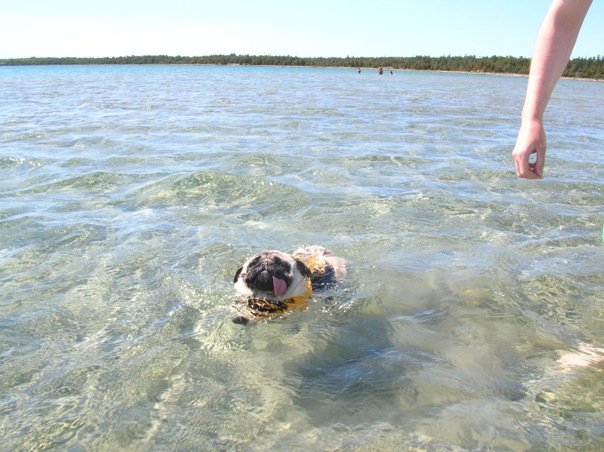
Love built of a long marriage: “Tongues” by Philip Martin. #Valentines #poetryisjustawesome

Tongues
(The speaker is a woman whose husband has died after a long illness)

Three days before he died the hospital called me:
He was unconscious, sinking. I went at once.
His face was closed, remote against the pillows.
I sat by the window.The leaves outside were moving
Suddenly he began to speak. I thought
He was asking me for something, but before
I could cross the room I saw have fixed his eyes were,
And then I realized: he was speaking verse,
But in a language neither of us knew.
Not English certainly, not German, and not Russian,
His family’s language from the thirteenth century,
Though he had never learnt it.
.                                              He continued
For a full minute, measured, authoritative.
I picked up the rhythm: four stresses to each line.
I recall only the opening words of one:
Alléndam tatsú…
.                         He seemed to be speaking
Past me, his eyes directed to the window,
Yet also to me. For thirty lines or more
He spoke, and then, as if the poem was finished,
Fell silent and lay back.
.                                   Two hours after,
He spoke once more, in German, using my name.
His eyes were soft and and again familiar.
We did not refer to the poem, then or later.
But though he was conscious almost until he died
He took no leave of me. And I think now
The poem was his taking-leave.
.                                                His doctor,
Who speaks German fluently, believes
That what I heard was German, much distorted.
I’m certain it was not: the voice was too
Distinct, unfaltering.
.                              His father said,
‘Ah, yes. Of course I need not remind you, we
Are an old family. It was our forbears speaking.’

Philip Martin

The New Oxford Book of Australian Verse, chosen by Les A. Murray.

USED: http://www.abebooks.com/servlet/BookDetailsPL?bi=14144434264


The Subway Piranhas by Edwin Morgan! And The Loch Ness Monster’s Song. Recorded at #LochNess: real sounds!!

The Subway Piranhas

Did anyone tell you
that in each subway train
there is one special seat
with a small hole in it
and underneath the seat
is a tank of piranha-fish
which have not been fed
for quite some time.
The fish become quite agitated
by the shoogling of the train
and jump up through the seat.
The resulting skeletons
of unlucky passengers
turn an honest penny
for the transport executive,
hanging far and wide
in medical schools.

From: Poems on the Underground, edited by Chernaik, Herbert and Benson.
Buy NEW and USED at abebooks: Poems on the Underground!!!

The Loch Ness Monster’s Song

Sssnnnwhuffffll?
Hnwhuffl hhnnwfl hnfl hfl?
Gdroblboblhobngbl gbl gl g g g g glbgl.
Drublhaflablhaflubhafgabhaflhafl fl fl –
gm grawwwww grf grawf awfgm graw gm.
Hovoplodok – doplodovok – plovodokot-doplodokosh?
Splgraw fok fok splgrafhatchgabrlgabrl fok splfok!
Zgra kra gka fok!
Grof grawff gahf?
Gombl mbl bl –
blm plm,
blm plm,
blm plm,
blp.

Buy NEW and USED at abebooks: Collected Poems by Edwin Morgan!


A mother’s yearning/love: “Your clear eye is the one absolutely beautiful thing…” Sylvia Plath #Valentines #poetryisjustawesome

Child by Sylvia Plath

Your clear eye is the one absolutely beautiful thing.
I want to fill it with color and ducks,
The zoo of the new

Whose names you meditate —
April snowdrop, Indian pipe,
Little

Stalk without wrinkle,
Pool in which images
Should be grand and classical

Not this troublous
Wringing of hands, this dark
Ceiling without a star.

.

.

From: Poems on the Underground. Illlustrated edition. Edited by Judith Chernaik, Gerard Benson and Cicely Herbert.


No need to spell out love— poems: “Beyond the last horizon/We’ll see what there is to see…” #TweetHearts #Valentines

When you don’t have to spell out that you love.

North London Sonnet
for Lucinda

A boom-box boats by,
less music than sonic muscle
assaulting the night sky,
a pumped-up hustle-bustle

which manages to disturb
the twirly, needling alarm
of a car tucked into the kerb—
its mantra, or charm—

but that too, soon, quiets
and you sleep on, proof
against the rumpuses and riots
encircling our roof,

till my switching off the light
prompts a muffled Good Night

Christopher Reid

From: London a History in Verse, ed by Mark Ford.

NEW: http://www.localbookshops.co.uk
USED: http://www.abebooks.com/servlet/BookDetailsPL?bi=9186279941
Canto IV

[…]
You know your glance bedecks the sailboats
In the rocking nights of the catch
You know your glance ties the knot of stars
And the knot of song that will come from this chest
Your glance carries the word to the heart
And the enchanted mouth of a nightingale

There’s no time to lose
At the hour of the body in the dubious shipwreck
I measure the infinite step by step

The sea waits to conquer
So there’s no time to lose
Then
.    Ah then

Beyond the last horizon
We’ll see what there is to see

[…]

Vicente Huidobro

From: Pinholes in the Night, essential poems for Latin America. Selected by Raul Zurita, edited by Forrest Gander.

USED and NEW: Pinholes in the Night at Abebooks.com.

Love poems that are boss of Valentine’s Day: “…Your dream will sleep in my hands…”

Canto IV
[…]
And I lifted the cape of your laughter
And I cut through the shadows
That cast the signs of distance over you

Your dream will sleep in my hands
Marked with the lines of my inseparable fate
In the breast of the same bird
That consumes itself in the fire of its song
Of its song that weeps for time
For time slips through fingers

[…]
I love my eyes and your eyes and eyes
Eyes with their own flash-point
Eyes that dance to the sound of an inner music
And open like a door onto a crime
[…]
Vicente Huidobro

From: Pinholes in the Night, essential poems for Latin America. Selected by Raul Zurita, edited by Forrest Gander.

USED and NEW: Pinholes in the Night at Abebooks.com.

Rain Journal: London: June 65
by Lee Harwood

sitting naked together
on the edge of the bed
drinking vodka

this my first real love scene

your body so good
your eyes sad love stars

but John
now when we’re miles apart
the come-down from mountain visions
and the streets all raining
and me in the back of the shop
making free phone calls to you

what can we do?

crackling telephone wires shadow me
and this distance haunts me
and yes – i am miserable
and lost without you

whole days spent
remaking your face
the sound of your voice
the feel of your shoulder
.

From: London a History in Verse, ed by Mark Ford.

NEW: http://www.localbookshops.co.uk
USED: http://www.abebooks.com/servlet/BookDetailsPL?bi=9186279941

I shall drown you in love poems. By Valentine’s Day you will be able to face the chocolate hearts and red red roses!

Not typical love poems, although some are.

Freedom, summer (To my mother, reminding her of the fire)

I hold the photo of two lovers who fell into the sea. They’re dressed
.   for winter, I ask them to take off their clothes. During siestas we sit
.   beside the water pump and stare at each other: light collects in her
.   breasts again; he loved horses and one time he tried to kill himself. (1978)

La Libertad, el verano (A mi madre, recordándole el fuego)

Tengo la foto de dos novios que cayeron al mar. Están vestidos de
.   invierno, los invito a desnudarse. En las siestas nos sentamos junto
.   a la bomba de agua y nos miramos: de nuevo embolsan luz los
.   pechos de ella; él amaba a los caballos y una vez intentó suicidarse. (1978)

For more on Héctor Viel Témperley go here!

Canto IV
[…]
Rose upturned and rose returned and rose and rose
Though the warden don’t want it
Muddy rivers make for clean fishing.
[…]

Vicente Huidobro

From: Pinholes in the Night, essential poems for Latin America. Selected by Raul Zurita, edited by Forrest Gander.

USED and NEW: Pinholes in the Night at Abebooks.com.

Stations by Audre Lorde

Some women love
to wait
for life          for a ring
in the June light          for a touch
of the sun to heal them           for another
woman’s voice       to make them whole
to untie their hands
put words in their mouths
form to their passages      sound
to their screams        for some other sleeper
to remember         their future         their past.

Some women wait for their right
train          in the wrong station
in the alleys of morning
for the noon to holler
the night come down.

Some women wait for love
to rise up
the child of their promise
to gather from earth
what they do not plant
to claim pain for labor
to become
the tip of an arrow       to aim
at the heart of now
but it never stays.

Some women wait for visions
That do not return
Where they were not welcome
Naked
For invitations to places
They always wanted
To visit
To be repeated.

Some women wait for themselves
Around the next corner
And call the empty spot peace
But the opposite of living
Is only not living
And the stars do not care.

Some women wait for something
To change        and nothing
Does change
So they change
Themselves.


From The Oxford Anthology of African-American Poetry.
NEW and USED: Abebooks.com The Oxford Anthology of African-American Poetry
NEW at independent bookstores: http://www.indiebound.org/book/9780195125634

For the *person* I loved so much, my pug Tommie. 8.9.2001- 24.1.2015 Go snuggle some place nice!

5022_384286841654311_1515368800_nI imagine her comfortable in a little bed looking at me:

Do not stand at my grave and weep

Do not stand at my grave and weep
I am not there; I do not sleep.
I am a thousand winds that blow,
I am the diamond glints on snow,
I am the sunlight on ripened grain,
I am the gentle autumn rain.
When you awaken in the morning’s hush
I am the swift uplifting rush
Of quiet birds in circled flight.
I am the soft stars that shine at night.
Do not stand at my grave and cry,
I am not there; I did not die.

1410792_10201773201145672_1092475997_oAnd another one that reminds me of her pugginess and love of sun:

Wordsworth’ Daffodils

I wandered lonely as a cloud
That floats on high o’er vales and hills,
When all at once I saw a crowd,
A host, of golden daffodils;
Beside the lake, beneath the trees,
Fluttering and dancing in the breeze.

For oft, when on my couch I lie
In vacant or in pensive mood,
They flash upon that inward eye
Which is the bliss of solitude;
And then my heart with pleasure fills,
And dances with the daffodils.

And:

Remember me when I am gone away,
Gone far away into the silent land;
When you can no more hold me by the hand,
Nor I half turn to go yet turning stay.
Remember me when no more day by day
You tell me of our future that you plann’d:
Only remember me; you understand
It will be late to counsel then or pray.
Yet if you should forget me for a while
And afterwards remember, do not grieve:
For if the darkness and corruption leave
A vestige of the thoughts that once I had,
Better by far you should forget and smile
Than that you should remember and be sad.

Rossetti

202185_4239688264381_2083941327_o

And by Elizabeth Barrett Browning:

— I love thee with the breath,
Smiles, tears, of all my life; and, if God choose,
I shall but love thee better after death.

205103_1051554923040_7217_n

A sad poem:

IX.
Stop all the clocks, cut off the telephone,
Prevent the dog from barking with a juicy bone,
Silence the pianos and with muffled drum
Bring out the coffin, let the mourners come.

Let aeroplanes circle moaning overhead
Scribbling on the sky the message She Is Dead,
Put crêpe bows round the white necks of the public doves,
Let the traffic policemen wear black cotton gloves.

She was my North, my South, my East and West,
My working week and Sunday rest,
My noon, my midnight, my talk, my song;
I thought that love would last forever: I was wrong.

The stars are not wanted now: put out every one;
Pack up the moon and dismantle the sun;
Pour away the ocean and sweep up the wood;
For nothing now can ever come to any good

WH Auden

294590_2270775282787_1792519193_n

Fat piglets: Tommie and her brothers…

Adlestrop (This poem accompanies Pugs in the sun Everywhere)

BY EDWARD THOMAS

Yes. I remember Adlestrop—
The name, because one afternoon
Of heat the express-train drew up there
Unwontedly. It was late June.
The steam hissed. Someone cleared her throat.
No one left and no one came
On the bare platform. What I saw
Was Adlestrop—only the name
And willows, willow-herb, and grass,
And meadowsweet, and haycocks dry,
No whit less still and lonely fair
Than the high cloudlets in the sky.
And for that minute a blackbird sang
Close by, and round him, mistier,
Farther and farther, all the birds
Of Oxfordshire and Gloucestershire.


Snuggle close, sleep deep, snore loud, Tommie.
And find a place where I can smell and see you easily. Oh, Tommeleh, Moon face, Dogalopoulous, Pugminion, Pug-befje, Mopsehondicus… Champignon neus… the Tongue… Your eye lashes were so cute too.


Song Cycle of the Moon Bone, Wonguri-Mandjigai people. #nativelivesmatter #LifeLivedLikeaStory 1/3

Song Cycle of the Moon Bone

…The prawn is there, at the place of the Dugong, digging out mud with its claws
The hard-shelled prawn living there in the water, making soft little noises.

They are sitting about the camp, among the branches, along the
.        back of the camp;
sitting along in lines in the camp, they’re in the shade of the paperbark
.        trees:
sitting along in a line, like the new white spreading clouds;
In the shade of the paperbarks, they’re sitting like resting clouds.
People of the clouds, living there like the mist; like the mist sitting
.        resting with arms on knees,
In here towards the shade, in this Place, in the shadow of paperbarks.
Sitting there in rows, those Wonguri-Mandjigai people, paperbarks
.        along like a cloud.
Living on cycad-nut bread; sitting there with white-stained fingers,
Sitting in there resting, those people of the Sandfly clan…
Sitting there like mist, at that place of the Dugong… And of the
.        Dugongs Entrails…
Sitting resting there in the place of the Dugong…
In the place of the Moonlight Clay Pans, and at the place of the
.        Dugong…
There at that Dugong place they are sitting all along.

The prawn is there, at the place of the Dugong, digging out mud
.        with its claws…
The hard-shelled prawn living there in the water, making soft little
.        noises.
It burrows into the mud and casts it aside, among the lilies…
Throwing aside the mud, with soft little noises…
Digging out mud with its claws at the place of the Dugong, the place
.        of the Dugong’s Tail…
Calling the bone bukalili, The catfish bukalili, the frog bukalili, the
.        sacred tree bukalili,
The prawn is burrowing, coming up, throwing aside the mud, and
.        digging…
Climbing up on to the Lotus plants and onto their pods…

(Note from book: bukalili mans sacred epithet, power name)


USED: The New Oxford Book of Australian Verse at Abebooks!
chosen by Les A. Murray

“How the World Began!”: the Story of Crow. Indigenous creation story as told by Angela Sidney! #NativeLivesMatter

The Story of Crow.

(This poem starts with a daughter so precious that her parents did not want to lose her, ao they protected her and even though many men wanted her hand in marriage, they said she was too good for them. They all waited, I imagine, for the right man. She is referred to as ‘that girl.’)

Crow wanted to be born— he wants to make the world!

So he made himself into a pine needle.
A slave always brings water to that girl and one time he gets water
.   with a pine needle in it.
She turns it down— make him get freshwater.
Again he brings it. Again a pine needle is there.
Four times he brings water and each time it’s there.
Finally she just give up— She spit that pine needle out and drink the
.   water.
But it blew into her mouth and she swallowed it.
Soon the girl is pregnant.

Her mother and daddy are mad.
Her mother asks, “Who’s that father?”

“No, I never knew a man,” she told her mother.

That baby starts to grow fast.
That girl’s father had the sun, moon, stars, daylight hanging in his
.   house.
He’s the only one that has them.
The world was all dark, all the time.
The child begged for them to play with.

Finally, the father gives his grandchild the sun to play with.
He rolls it around, plays with it, laughs, has lots of fun.
Then he rolls it to the door and out it goes!
“Oh!” he cries. He just pretends.
He cries because that sun is lost.

“Give me the moon to play with.”

They say no at first— like now, if a baby asks for the sun or moon you
.   say,
“That’s your grandfather’s fire.”

Finally, they gave it to him.

One by one they gave him the sun, moon, stars, daylight—
He loses them all.

“Where does she get the child from? He loses everything!”
That’s what her father says.

Then Crow disappears.
He has to things with him in the box.
He walks around— comes to a river.
Lots of animals there— fox, wolf, wolverine, mink, rabbit.
Everybody’s fishing…
That time animals all talk like people talk now—
The world is dark.

“Give me fish,” Crow says.
No one pay any attention.
“Give me fish or I’ll bring daylight!”
They laugh at him.

He’s holding a box… starts to open it and lets one ray out.
Then they pay attention!
He opens that books a bit more—they are scared!
Finally he opens that daylight box and threw it out.
Those animals scatter!
They hide in the bush and turn into animals like now.
Then the sun, moon, stars, and daylight come out.

“Go to the skies,” Crow says.
“Now no man owns it— it will be for everybody.”

He’s right, what he says that Crow.

After Crow made the world, he saw that sea lion owned the only island
. in the world.
The rest was water— he’s the only one with land.
The whole place was ocean!
Crawl rests on a piece of log— he’s tired.
He sees see lion with that little island just for himself.
He wants some land to so he stole that sea lion’s kid.

“Give me back that kid!” said sea lion.

“Give me beach, some sand,” says Crow.

So sea lion gave him sand.
Crow threw that sand around the world.
“Be World,” he told it. And it became the world.

After that, he walks around, flies around all alone.
He’s tired— he’s lonely— he needs people.
He took poplar tree bark. You know how it’s thick?
He carved it and then he breathed into i.

“Live!” he said, and he made a person.
He made Crow and Wolf to too.
At first they can’t talk to each other—
Crow man and woman are shy with each other— look away.
Wolf the same way too.

“This is no good,” he said. So we change that.
He made Crow man sit with Wolf woman.
And he made Wolf Man sit with Crow woman.
So Crow must marry Wolf and Wolf must marry Crow.

That’s how the world began.
.
.

“You tell what you know.
The way I tell stories is what I know.”

Angela Sidney.

.

.

As told by Angela Sidney in “Life Lived Like a Story: Life Stories of Three Yukon Native Elders.” By Julie Cruikshank, p. 42.

Library in Toronto: http://www.torontopubliclibrary.ca/detail.jsp?Entt=RDM521988&R=521988

Order online:
– NEW: http://www.ubcpress.ca/search/title_book.asp?BookID=444 or at http://www.indiebound.org
– USED: http://www.abebooks.com/servlet/SearchResults?sts=t&tn=Life+Lived+Like+a+Story

‪#‎IndigenousLivesMatter‬ ‪#‎WinterSolstice‬ ‪#‎WinterSolsticebonfire‬ ‪#‎AmINext‬

.

Start of story:
“One time there was a girl whose daddy is a very high man.
They kept her in her bedroom all the time—
Men try to marry her all the time, but they say no, she’s too good.”
The Old Woman under the World, told by Angela Sidney. #LifeLivedLikeaStory #nativelivesmatter

The Old Woman under the World.

There are two old ladies down below who look after the world.
One is supposed to be sleeping;
The other one holds up the earth with a pole.
When she shakes it, that’s when there’s supposed to be an earthquake.
That old lady there with the pole is supposed to be Death.
She always argues– She’s the one who always says, “let people sleep for good when they go to sleep.
Let them die.”

That Death Woman wants to kill people before their time.

But Sleep Woman says,
“No!
Can’t you see how my boss put a good pillow for me to sleep on?
And you want me to let her go to sleep for good?
No. No—I won’t do that.
Those old ladies—
One is Sleep Woman, the other is Death Woman.

brothers, who will hold her, who will find her beautiful if you do not? Lucille Clifton. #OscarsSoWhite

song at midnight

brothers,
this big woman
carries much sweetness
in the folds of her flesh.
her hair
is white with wonderful.
she is
rounder than the moon
and far more faithful.
brothers,
who will hold her,
who will find her beautiful
if you do not?

won’t you celebrate with me
what i have shaped into
a kind of life? i had no model.
born in babylon
both nonwhite and woman
what did i see to be except myself?
i made it up
here on the bridge between
starshine and clay,
my own hand holding tight
my other hand; come celebrate
with me that everyday
something has tried to kill me
and has failed.

Lucille Clifton

.

From The Oxford Anthology of African-American Poetry.
NEW and USED: Abebooks.com The Oxford Anthology of African-American Poetry
NEW at independent bookstores: http://www.indiebound.org/book/9780195125634

Snow White was nude at her wedding, she’s so white… #OscarsSoWhite #ThyliasMoss #poetryisjustawesome

Lessons from a Mirror

Snow White was nude at her wedding, she’s so white
the gown seemed to disappear when she put it on.

Put me beside her and the proximity is good
for a study of chiaroscuro, not much else.

Her name aggravates me most, as if I need to be told
what’s white and what isn’t.

Judging strictly by appearance there’s a future for me
forever at her heels, a shadow’s constant worship.

Is it fair for me to live that way, unable
to get off the ground?

Turning the tables isn’t fair unless they keep turning.
Then there’s the danger of Russian roulette

and my disadvantage: nothing falls from the sky
to name me.

I am the empty space where the tooth was, that my tongue
rushes to fill because I can’t stand vacancies.

And it’s not enough. The penis just fills another
gap. And it’s not enough.

When you look at me,
know that more than white is missing.

.

From The Oxford Anthology of African-American Poetry.
NEW and USED: Abebooks.com The Oxford Anthology of African-American Poetry
NEW at independent bookstores: http://www.indiebound.org/book/9780195125634

About the meaning read this post by Tara Betts: ““Lessons from a Mirror” is from Moss’ third collection. Pyramid of Bone was part of the Callaloo Poetry Series, which published early books by Rita Dove, Brenda Marie Osbey, and Elizabeth Alexander.

Lessons from a Mirror” is a concise gathering of 10 couplets that articulates the contrast between a woman of color and someone who she will never be, Snow White.

[…]

This not only implies a sense of possible servitude but a sense that a shadow, darkness will always be beneath whiteness that

darkness must bow and defer as an underling.

[…]

“And it’s not enough.” To say this, recalls how black people have often had to work much

harder to gain a toehold

similar to counterparts of another race, a toehold that has become increasingly more difficult to gain as shown in recent Pew Research Center study about wealth accumulation and loss in the U.S..

[…]

After revisiting Anne Sexton’s poems in Transformations or Lucille Clifton’s biblical poems many times and looking at recent work like Barbara Jane Reyes’ Diwata, Marjorie Tesser’s The Magic Feather, Aimee Nezhukumatathil’s Miracle Fruit, Angela Carter’s The Bloody Chamber, and the anthology The Poets’ Grimm, I’m reminded of how necessary

and jarring it is to see

archetypal stories deconstructed, retold, or even replaced with more inclusive stories.”

USED and NEW– books by Tara Betts at abebooks!

Little Girl Talk by Delores S. Williams.

Little Girl Talk

my grampaw was a smooth black, way back then
before black discovered beautiful he was pretty.
he had pearlywhite teeth and a big moustache.
he useta skinny-out to the edge with a black-wax stick. on Sunday
he would pindown in his darkblue suit, wideblue tie.
white-stiff shirt, and hip-on down to the presbyterian church where he argued
over how to spend white folk’s mission money.

on weekdays: overalls. he worked in a factory.
until some white boss talked down to him. then he’d quit.
to another factory. talk union talk to negroes. get
laid off. on the way home buy me a big box of oran
kause i kalled iron ‘i-roan’.

my grampaw was all the kings i wanted to know. when
i was six. my grampaw was smart. didn’t
go to college. said white folks wouldn’t let’im.
but he worked algebra and trig and read gladstone’s law.
and science books. he used to tell us kids
there wasn’t no heaven.

my grampaw said i was the sugar in his coffee. yes indeed.
i remember my grampaw,

the day the siren screamed into our street ballgame
and stopped at our house, we kids, eight of us, scattered
into an uneven line across the street. we watched two
big, redneck, white men in white uniforms stuff my
pretty grampaw into something called a straitjacket,
crowd him into the back of their looney wagon, jump
into the front themselves and shriek-off into the distance.
my grammaw stood perfectly still. her proud eyes
looked deep and sore and hollow. my mother, unmoving, cried softly.
i, girl-boy-tom-tree-climber of 10, tried
not to feel anything. the tears that didn’t come swelled
to a tight fist in my chest

big, brave, girlboy me
shove the weight of my ten years
onto two flat feet,
strolled to the middle of the street
and yelled as loud as i could,
“throw the ball, shity!”
.          The game was on.


Delores S. Williams

.

From The Oxford Anthology of African-American Poetry.

NEW and USED: Abebooks.com The Oxford Anthology of African-American Poetry
NEW at independent bookstores: http://www.indiebound.org/book/9780195125634

America by Henry Dumas. Black Poet. If we must die.

America

If an eagle be imprisoned
On the back of a coin
And the coin is tossed into the sky,
That coin will spin,
That coin will flutter,
But the eagle will never fly.

Henry Dumas.

From: The Oxford anthology of African-American poetry

NEW and USED: Abebooks.com The Oxford Anthology of African-American Poetry
NEW at independent bookstores: http://www.indiebound.org/book/9780195125634