New Year’s Poems. Happy 2015! 2/3

New Year on Dartmoor

This is newness: every little tawdry
Obstacle glass-wrapped and peculiar,
Glinting and clinking in a saint’s falsetto. Only you
Don’t know what to make of the sudden slippiness,
The blind, white, awful, inaccessible slant.
There’s no getting up it by the words you know.
No getting up by elephant or wheel or shoe.
We have only come to look. You are too new
To want the world in a glass hat.

Sylvia Plath

New Year (296)

One Year ago — jots what?
God — spell the word! I — can’t —
Was’t Grace? Not that —
Was’t Glory? That — will do —
Spell slower — Glory —

Such Anniversary shall be —
Sometimes — not often — in Eternity —
When farther Parted, than the Common Woe —
Look — feed upon each other’s faces — so —
[…]

Emily Dickenson

New Year’s poems. Happy 2015!! 1/3

and to the start of one new year…

Welcoming in plenty
of new year’s rain
Rackety house!

old blue pine
embarking on a new year
how many spring mists?

New Year’s Day–
everything is in blossom!
I feel about average

After this night
a new year dawns
children

Year’s end,
all corners
of this floating world, swept

warmly
I greet the new year
temple verandah

Issa
.

Goodnight to the Season
(Thus runs the world away.—Hamlet) and slightly changed for my own fun.

Goodnight to the Season!—another
Will come, with its trifles and toys,
And hurry away, like its brother,
In sunshine, and scents, and noise.
Will it come with a rose or a briar?
Will it come with a blessing or curse?
Will its jeans be lower or higher?
Will its morals be better or worse?
Will it find me grown thinner or fatter,
Or fonder of wrong or of right,
Or married—or buried?—no matter:
Goodnight to the Season, Goodnight!

By Winthrop Mackworth Praed

Auld Lang Syne
“the song that nobody knows.”

Should auld acquaintance be forgot,
And never brought to mind?
Should auld acquaintance be forgot,
And auld lang syne!

Chorus.-For auld lang syne, my dear,
For auld lang syne.
We’ll tak a cup o’ kindness yet,
For auld lang syne.

Written down by Robert Burns

Woman in Black movie poem. Susan Hill, Justin Evett.

Woman in Black. Creepy sad longing poem.

During afternoon tea
There’s a shift in the air
A bone-trembling chill
That tells you she’s there
There are those who believe
The whole town is cursed
But the house on the marsh
Is by far the worst
[…]
Have you seen her?
The woman in black?
She once lost her boy and now shes come back
Our parents all worry
they make such a fuss
For if she cant find him
she’ll take one of us

.

Another The Woman in Black poem:

She walks down the stairs
dressed in all black,
to the thought of a memory
she hopes to bring back.

The band starts to play
and the floor starts to dance,
the song sounds familiar
as they slip into a trance.

The lights begin to dim
as the candle fire lights,
every one waits
for the slowly approaching night.
[…]
She spoke of one word
then the house became his tomb,
he fell to his death
along with the entire room.

Justin Evett

The streets of London, UK. Smash the Windows by Maura Dooley!

By Maura Dooley. This is how I remember London and the summers I spent in Tufnell Park Road with family friends. Curry the favourite dish, sambal on a sandwich, dog in the park, someone paid to clean the park, pale day light and shortcuts that sometimes ended up in a different place that only looked alike.

Smash the Windows.
OR, TEN SOUTH LONDON FIDDLE TUNES

1. The Misted Pane
2. Egg on a Bap
3. Knock at the Door
4. A Draught of Air
5. Turd on the Step
6. Fox in a Wheelie Bin
7. Toke on the Swings
8. Parakeet in the Oak
9. The Short Way Home
10. Glass on the Pavement

Tufnell_Park_-_geograph.org.uk_-_261505
.
.
Homesick for London. Especially Tufnell Park and Hyde Park, Kew Gardens, Nando’s Charing Cross Road, National Portrait Museum, Southwark Cathedral, Royal Festival Hall…The Docklands.
.
From: London a History in Verse, ed by Mark Ford.

NEW: http://www.localbookshops.co.uk
USED: http://www.abebooks.com/servlet/BookDetailsPL?bi=9186279941

http://www.telegraph.co.uk/foodanddrink/10564444/Curry-why-the-British-are-moving-on-from-Chicken-Tikka-Masala.html

Hello Miss Pretty Bitch by Emily Yoon thru Poets Respond!!

Emily Yoon

HELLO MISS PRETTY BITCH

the street drummer
calls out in Korean
no doubt thinking it
a compliment
a pleasant surprise
cinched with red ribbons
for Christmas the day
select theatres will gift us
with The Interview
a comedy in which
two American journalists
ignite Kim Jong-un’s face
freedom has prevailed
the film’s star Seth Rogen
says about the release
the same was thought
at the time of Korea’s release
from the Japanese Empire
though then the Korean War
began and compared to war
what’s so bad about a movie
anyway even war can be funny
and now a drummer
in New York says
you got a smile 
that could light up
the whole town 
though I’m not smiling
thinking about villages
and cities of what became
North Korea set on fire
sending puddles of twilight
into sunless skies
as if flames could stab
but his freedom
of speech prevails
freedom always prevails
which is why we get to see
two Americans
incinerate a Korean face
on Christmas
hold our popcorn
and chocolate bars
and laugh as the dictator
explodes in tune
to a pop song
laugh as American
soldiers would laugh
at Korean children
chanting hello hello 
gibu me choco-let
with wartime hunger
laugh as they choose
which face
to light up

Poets Respond
December 28, 2014

Emily Yoon: 

“I wrote this poem as a reaction to how friends and acquaintances responded to the news, and how Seth Rogen Tweeted, ‘The people have spoken! Freedom has prevailed! […]’ on the film’s release. 

As a Korean-born person, it was always curious to me how many people in the US feel entitled to dehumanize North Korea 

and condemn North Korea-South Korea relations under the name of humour and freedom of speech, 

without enough awareness on the role of the US in the Korean War and the subsequent demarcation.”

SUBMIT your own poem: https://rattle.submittable.com/submit/30232

This poem has been published exclusively online as part of a new project in which poets respond to current events. A poem written within the last week about an event that occurred within the last week will appear every Sunday at Rattle.com. “

http://www.rattle.com/poetry/hello-miss-pretty-bitch-by-emily-yoon/

R. P. Blackmur, Mirage

So painfully beautiful this sentence, I can’t read it without my heart hurting. Unbelievably beautiful.

The wind was in another country, and

the day had gathered to its heart of noon

the sum of silence, heat, and stricken time.


R. P. Blackmur Mirage


The wind was in another country, and

the day had gathered to its heart of noon

the sum of silence, heat, and stricken time.

Not a ripple spread. The sea mirrored

perfectly all the nothing in the sky.

We had to walk about to keep our eyes

from seeing nothing, and our hearts from stopping

at nothing. Then most suddenly we saw

horizon on horizon lifting up

out of the sea’s edge a shining mountain

sun-yellow and sea-green; against it surf

flung spray and spume into the miles of sky.

Somebody said mirage, and it was gone,

but there I have been living ever since.

Anna Akhmatova: memory, love, lust and loss.

Anna Akmatova: “Russian modernist poet, one of the most acclaimed writers in the Russin canon…Her style, characterised by its economy and emotional restraint, was strikingly original and distinctive to her contemporaries. The strong and clear leading female voice struck a new chord in Russian poetry.”

All three poems seem to show her at peace. I can’t believe that someone who decided not to emigrate from Russia but brave Stalin’s murderous reign is at peace. I think she was trying to convince herself that she is not on edge but balanced, not lost in pain of white death, nor off balanced by longing and lust. She says she is old, and it’s cold outside, and that something made her feel young and warm, the guest who wants to kiss her, who wants to own her, who wants to show her that the young men? women? know nothing of how to kiss. I think in the third poem she does wake up warm and happy, a saint’s day is a festivity -albeit one for the day the saint associated with your name, died. Not sure why communicants sleeplessly sleep. I read that waking up from sleep is seen as resurrection and that communicants partake in Jesus’ body’s resurrection. I found the line “may we not sleep in sins, but awake and rejoicing in his praises”. What that means together is not clear to me: maybe that she was rejoicing in his name-day while she was asleep, unconsciously celebrating already. That’s a nice thought about sleeping with happiness because of someone else’s joy.

Memory’s Voice

For O. A. Glebova-Sudeikina

‘What do you see, on the wall, dimly alive,
At that hour when the sunset eats the sky?

A seagull, on a blue cloth of waters,
Or perhaps it’s those Florentine gardens?

Or is it Tsarskoye Seloe’s vast view,
Where terror stepped out before you?

Or that one who left your captivity,
And walked into white death, freely?’

No, I see only the wall – that shows
Reflections of heaven’s dying glow.

The Guest

All’s as it was: the snowstorm’s
Fine flakes wet the window pane,
And I myself am not new-born,
But a man came to me today.

But, his dry hand touched
A petal with a light caress:
‘Tell me, how they kiss you,
Tell me, how you kiss.’

8th November 1913

Sunlight fills my room
With hot dust, lucent, grey.
I wake, and I remember:
Today is your saint’s day.
That’s why even the snow
Is warm beyond the window,
That’s why, sleeplessly,
Like a communicant, I slept.

Translated by A. S. Kline © 2005, 2012 All Rights Reserved.

“Her work was condemned and censored by Stalinist authorities and she is notable for choosing not to emigrate, and remaining in Russia, acting as witness to the atrocities around her. Her perennial themes include meditations on time and memory, and the difficulties of living and writing in the shadow of Stalinism.”

More easy to read information: http://en.wikipedia.org/wiki/Anna_Akhmatova

Because snow and ice are pretty, cold. Haiku.

The snow is melting
and the village is flooded
with children.

Issa

Looking at the clouds
blue in the ice-wind
space flows.

Thomas Grieg

No sky
no earth- even so
snowflakes fall.

Hashin

A little bell in the window, T. Ismail. Indonesia!

A little bell in the window

A little bell hungdanglingswaying in the window
In the month of June
Lonely cling-e-ling

Tamarind leaf and tjilping of a sparrow
Clicketyclack of the andong horses in Jogja
Old city that stretches itself in dust
Throughout the alley the lonesome is scattered
A little bell hungdanglingswaying in the window
In the month of June
Lonely
Cling-
el-
ling

Dutch: Een belletje in het raam

Een belletje opgehangen in het raam
In de maand Juni
Eenzaam klingelend

Tamarindeblad en getjilp van een mus
Geklikklak van de andongpaarden in Jogja
Oude stad die zich uitstrekt in stof
Door de steeg heen wordt het eenzame verstrooid
Een belletje opgehangen in het raam
In de maand Juni
Eenzaam
Kling-
el-
lend

Taufiq Ismail
Dutch translated by Linde Voûte

Uit: Ik wil nog duizend jaar leven. Negen moderne Indonesische dichters. Meulenhoff, Amsterdam,1979. Poetry International Serie. Put together by Harry Aveling.

BUY:
http://www.bol.com/nl/p/ik-wil-nog-duizend-jaar-leven/1001004005110174/
ISBN13 9789029008778

Surinam poetry. Poezie gedichten geluid uit Suriname!! (Latin-America)

Screen Shot 2014-12-26 at 10.52.07 PM
Galibi beach, Surinam.

A tree, hosts of sparrows
and amongst them
one other bird.

Een boom vol mussen
en daartussen
een andere vogel.

Geerdi, 9 jaar.

Coconut palm
under the flowing wind […]

Kokospalm
onder de vloeiende wind

Michaël Slory
[uit: Waar wordt de lucht gemolken?, 2004]

Sranan tongo:
“Orfeu negro”
Mi sa singi a son opo kon

I will sing
the sun
to rise

With the stars washed away
from the sky
I will sing
in clouds of orange,
Flecked loin cloths of redblue,
Black, that can’t keep itself standing

When my sun arrives
A yellow message
For all who still lay in their camps
for all who are blind with sleep…

I shall sing
The sun
Rise

From out of the water
That is so endlessly broad
Until you come outside
To listen
To the message that from my heart
Bursts out
A few droplets of the morning sun.

Dutch:
Ik zal zingen
de zon rijst
komt te voorschijn

Wanneer de sterren weggewassen zijn
Uit de lucht
Ik zal zingen
In wolken van oranje,
Bespikkelde lendendoeken van roodblauw,
Zwart, dat zich niet langer kan staande houden

Wanneer mijn zon aankomt
Een gele boodschap
Voor allen die nog in hun kampen liggen
Voor allen die blind zijn van slaap…

Ik zal zingen
Om de zon
Te laten opkomen

Vanuit het water
Dat zo eindeloos breed is
Totdat jullie naar buiten komen
Om te luisteren
Naar het bericht dat vanuit mijn hart
Naar buiten breekt
Enkele druppels van de morgenzon

Sranan tongo:
Mi sa singi
A son
Opo kon,

Te den stari wasi komoto
Na loktu
Mi sa singi
Alanya worku,
Penipeni pangi fu rediblaw
Blaka, di no man ori ensrefi
Te mi son e kon
Wan geri boskopu
Fu ala di didon ete na ini den kanpu
Fu ala di e sribi breni..

Mi sa singi
A son
Opo kon,

Fu ondro a watra
Di bradi sote
Te un opo kon na doro
Fu arki
A nyunsu di mi ati
E lusu
Wanwan dropu fu mamanten son

Michael Slory [1935]

“The river is deep… ” by Najam Hosain Syed (Shah Hussein)

The River is deep and the shaky bridge creaks as people step on it. And the ferry is a known haunt of tigers.

[…]

From “Courtesy” by Najam Hosain Syed (Shah Hussein).

“Grandson of a convert weaver, he embarrassed every one by aspiring to the privilege of learning what the revered guardians of traditional knowledge claimed to teach.”

Hat tip: http://razarumi.wordpress.com

Breasts, beautiful breasts. 2/2

The Olympic Girl by John Betjeman.
[…]
Oh! would I were her racket press’d
With hard excitement to her breast
And swished into the sunlit air
Arm-high above her tousled hair,
[…]
And when the match is over, I
Would flop beside you, hear you sigh;
And then with what supreme caress,
You’d tuck me up into my press.
Fair tigress of the tennis courts,
So short in sleeve and strong in shorts,


Her foot sparkled like silver
splashing bath water
on her golden apple breasts,
grown heavy with their milk […]

.
~Rufinus, 2nd century BCE

My breasts are like martinis

[…]

When I have a migraine and she reaches for me, I say
Josey, my breasts are like martinis. She nods, solemn:
People should keep their goddamn hands off yours. How
could we tell these jokes to the bartender? We can’t. He’ll never know.
I say it after scrubbing the kitchen cabinets, and she gets it:
dirty and wet. Walking in the wind, Josey says My breasts
are like martinis
 and I hail a cab, know she means shaking, ice cold.

Jill McDonough, Stanford University.

Her sweet weight on my Heart a Night 

Her sweet weight on my Heart a Night 
Had scarcely deigned to lie –
When, stirring, for Beliefs delight,
My bride had slipped away – If `twas a Dream – made solid – just
The Heaven to confirm – 
Or if Myself were dreamed of Her – 
The power to presume – With Him remain – who unto Me –
Gave – even as to All –
A Fiction superseding Faith –
By so much – as `twas real –

Emily Dickinson.

Your two breasts are like two fawns

Your two breasts are like two fawns,
like twin fawns of a gazelle
that browse among the lilies.

Song of Solomon 4:5 (1)

Have ye beheld (with much delight)
A red rose peeping through a white?
Or else a cherry (double graced)
Within a lily? Centre placed?
Or ever marked the pretty beam
A strawberry shows half drowned in cream?
Or seen rich rubies blushing through
A pure smooth pearl, and orient too?
So like to this, nay all the rest,
Is each neat niplet of her breast.
.
Her breast is fit for pearls by Emily Dickinson
.
Her breast is fit for pearls,
But I was not a “Diver”—
Her brow is fit for thrones
But I have not a crest.
Her heart is fit for home—
I—a Sparrow—build there
Sweet of twigs and twine
My perennial nest.
.
.
The first part of this post about beautiful breasts is at:
.
.

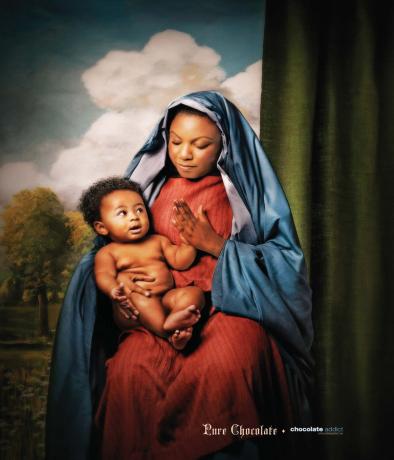
Little Brown Baby by Paul Laurence Dunbar

black-baby-jesus
Photo: Matt Barnes Art direction: Natasha Romanelli, Ann Aberin

* For parents and others who love the adorableness of scallywags.
* I love how people squoosh language.
* Sometimes I look at old old poems and I feel amazing that words change and grammar too. It is pretty fantastic. “hebban olla vogala nestas bagunnan hinase hic enda thu wat unbidan we nu” Old (west) Dutch/old Kentish used to be very similar!!

Little Brown Baby
BY PAUL LAURENCE DUNBAR

Little brown baby wif spa’klin’ eyes,
Come to yo’ pappy an’ set on his knee.
What you been doin’, suh — makin’ san’ pies?
Look at dat bib — you’s es du’ty ez me.
Look at dat mouf — dat’s merlasses, I bet;
Come hyeah, Maria, an’ wipe off his han’s.
Bees gwine to ketch you an’ eat you up yit,
Bein’ so sticky an sweet — goodness lan’s!

Little brown baby wif spa’klin’ eyes,
Who’s pappy’s darlin’ an’ who’s pappy’s chile?
Who is it all de day nevah once tries
Fu’ to be cross, er once loses dat smile?
Whah did you git dem teef? My, you’s a scamp!
Whah did dat dimple come f’om in yo’ chin?
Pappy do’ know you — I b’lieves you’s a tramp;
Mammy, dis hyeah’s some ol’ straggler got in!

Let’s th’ow him outen de do’ in de san’,
We do’ want stragglers a-layin’ ‘roun’ hyeah;
Let’s gin him ‘way to de big buggah-man;
I know he’s hidin’ erroun’ hyeah right neah.
Buggah-man, buggah-man, come in de do’,
Hyeah’s a bad boy you kin have fu’ to eat.
Mammy an’ pappy do’ want him no mo’,
Swaller him down f’om his haid to his feet!

Dah, now, I t’ought dat you’d hug me up close.
Go back, ol’ buggah, you sha’n’t have dis boy.
He ain’t no tramp, ner no straggler, of co’se;
He’s pappy’s pa’dner an’ play-mate an’ joy.
Come to you’ pallet now — go to yo’ res’;
Wisht you could allus know ease an’ cleah skies;
Wisht you could stay jes’ a chile on my breas’—
Little brown baby wif spa’klin’ eyes!

Link

Creation story

God’s child kept blocks in his apron’s pocket,
which it had been playing with in the clouds.
But when she, tired, bored, then wished to clear the decks
She saw into the box and could not fathom

how ever to fit them, neatly ordered stacked.
Because God was stern, but slept, so was no danger.
She let them drop, without a further glance
and made straight for a pretty sculpted angel.

The blocks fellthrough stark empty skies,
And reached an empty world, where
They remained as thrown.

Most shattered into hills and dales;
And those, whole, in one piece, formed here and there
the far wide cities and the smallest towns.

Translating, I departed from the rhymes and the almost rhymes out of necessity when the english words don’t rhyme and also because I want to show that Slauerhoff played with leaving out parts of speech, much like Joss Whedon encouraged in Buffy and Firefly. I think his play works especially well because the poem is about creating a world that is not there there and which has holes. Some of the loss of almost rhymes is sad because his choice of words was lovely. Learn Dutch!

“They remained as thrown” was the most difficult to translate because in Dutch part of the verb (“waren”=were) is left out but the last word of this line (geworpen=thrown) rhymes with the last word of the poem (dorpen). Anyway. It is a different poem in English. I love how Slauerhoff stops the story. Leaving the rest to our imagination. The whole poem stops and start and restarts at odd moments. How to play with language. When you read it aloud you need to leave space between inside some of the lines. Where depends on how you speak. The alliterations in the poem and inner rhymes are beautiful.

Also: I like he puts down the answer before we ask the question in the second stanza. He makes the lines work for him. Doesn’t let the mind dictate how he tells his story. Pay attention because G-d isn’t.

Third stanza is funny: you expect more but no.

Creation story

God’s child kept blocks in his apron’s pocket,
which it had been playing with in the clouds.
But when she, tired, bored, then wished to clear the decks
She saw into the box and could not fathom

how ever to fit them, neatly ordered stacked.
Because God was stern, but slept, so was no danger.
She let them drop, without a further glance
and made straight for a pretty sculpted angel.

The blocks fellthrough stark empty skies,
And reached an empty world, where
They remained as thrown.

Most shattered into hills and dales;
And those, whole, in one piece, formed here and there
the far wide cities and the smallest towns.

Dutch: Scheppingsverhaal.

Gods kind had blokken in zijn boezelaar,
Waarmee het in de wolken had gespeeld.
Maar toen zij op wou bergen, moe, verveeld,
Zag ze in de doos en wist niet hoe ze daar

In passen moesten, keurig ingedeeld.
Want God was streng, maar sliep – dus geen gevaar.
Zij liet ze vallen, zag er niet meer naar
Om en ging vlug naar een mooi engelbeeld.

De blokken vielen door een leeg heelal
En kwamen op een leege wereld, waar
Ze bleven zooals ze er heen geworpen.

De meeste sprongen stuk tot berg en dal.
En die heel bleven vormden hier en daar
De groote steden en de kleine dorpen.

© 1998, Erven J. Slauerhoff / K. Lekkerkerker / Uitgeverij Nijgh & Van Ditmar
From: Verzamelde gedichten
Publisher: Nijgh & Van Ditmar, Amsterdam, 1990.